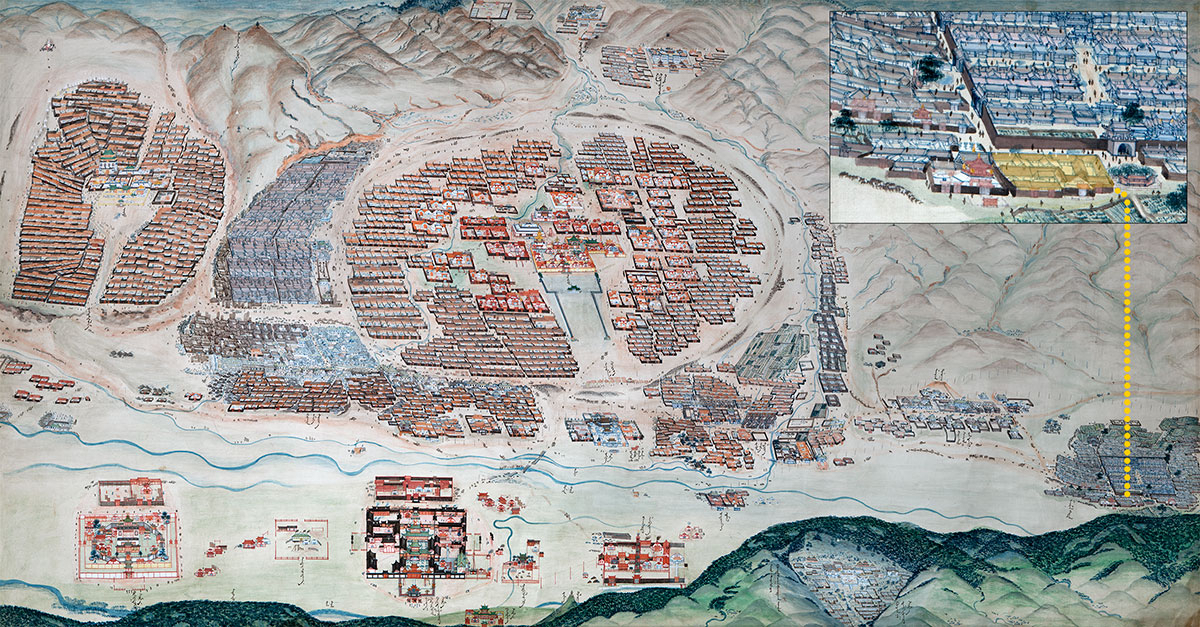
Jugder. Painting of Urga. 1913.
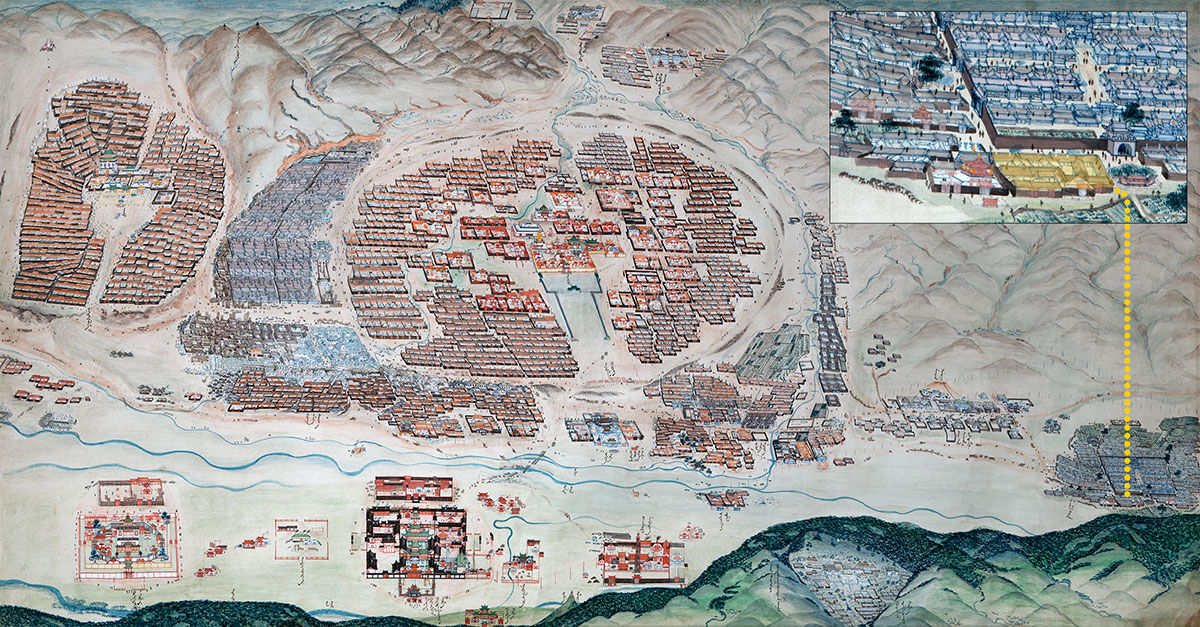
Following the yellow dotted line is Maimaachen, the Chinese part of Urga where Mamen resided with Lobsan, marked in yellow. To the left of Maimaachen was the Russian district, housing the Russian Consulate. The large circular formation in the middle was called Zuun Khuree, the administrative centre where the State Palace, the Yellow Palace, and the Maidar temple were located, and the large open space that currently is Sükhbaatar Square. Just below is the Choijin Lama temple, one of the few temple complexes still standing in Ulaanbaatar. South of Zuun Khuree were the lay districts, with the markets. To the very left in the painting was the Buddhist monastery Gandantegchenlin, the centre of religious education, also standing in present-day Ulaanbaatar. In between Gandantegchenlin and Zuun Khuree was another Chinese district. Below the Selba River were Bogd Khaan’s palaces, from the left: The White Palace, the Winter Palace, where Bogd resided (also called Green Palace), and the Summer Palace. The sacred mountain Bogd Khaan Uul is seen below Maimaachen. Mamen called everything west of the Russian district ‘West Urga’. Copyright Bogd Khaan Palace Museum.
Photo
B. Injinaash