
The TeCh-Coast project – “Technological Choices of Coastal populations: A functional perspective through the use-wear study of knapped lithic tools during the Late Mesolithic (6300-4500 cal BC) in south Norway” – is a Horizon Europe Marie Skłodowska-Curie Actions postdoctoral project (MSCA-PF-2023) that focus on the use of knapped stone tools and the technological traditions of Mesolithic coastal groups in southeast Norway.
The project is led by Jorge Calvo-Gómez, who is a MSCA postdoctoral researcher at the Museum of Cultural History, University of Oslo. He is co-supervised by Professor Almut Schülke, who is also coordinator of the MSCA network ArCHe, and Associate Professor Inger Marie Berg-Hansen. Both from the Museum of Cultural History, University of Oslo.
As part of the project, the researchers have recently carried out an experimental session in the area of Kristiansand, in Agder County.

View of the experimental setting.
Photo: Alexis Pantos/Museum of Cultural History, University of Oslo

A replica tool used for over an hour for filleting nine cods.
Photo: Alexis Pantos/Museum of Cultural History, University of Oslo

Jorge Calvo-Gómez making observations in the edge damage (wear) during the experiment.
Photo: Alexis Pantos/Museum of Cultural History, University of Oslo
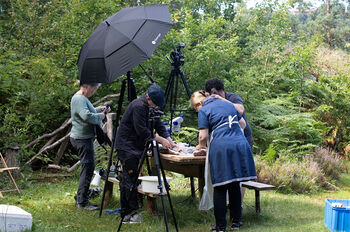


–For two days, we have been working to understand the mechanisms of the formation of use-wears during the processing of marine fishes. The experimental protocol aimed to set a controlled environment in which evaluate the impact of the different variables, such as the gesture, the user, the tool and the worked material, in the formation of the wear of the tools, explains Calvo-Gómez, research leader of the project.
Each of the replica tools was made of several materials; a flint blade, mounted on a hazelwood handle and glued with birch bark tar. The main experiment was executed by Morten Kutschera and Inger Marie Berg-Hansen, while Almut Schülke, Alexis Pantos and Jorge Calvo-Gómez recorded all the information and graphic documentation during the experiments.
–The experiments went very well, as the knives, and their users, showed to be very efficient for filleting the fishes. After almost five hours of work, we manage to process 34 entire cods, weighting from 2,2 to 4,9 kg, says Calvo-Gómez.
However, much work remains to be done. Soon, the TeCh-Coast project will perform new experiments to reproduce butchery activities, to compare the formation of the wears on the tools from butchering of large terrestrial animals to those of cutting marine fishes.
Later, these experimental flint blades will be analyzed by microscopic means to quantify precisely the wear formation. Ultimately this new data will be essential for understanding the technological choices of the coastal human groups during the Late Mesolithic period in South Norway.