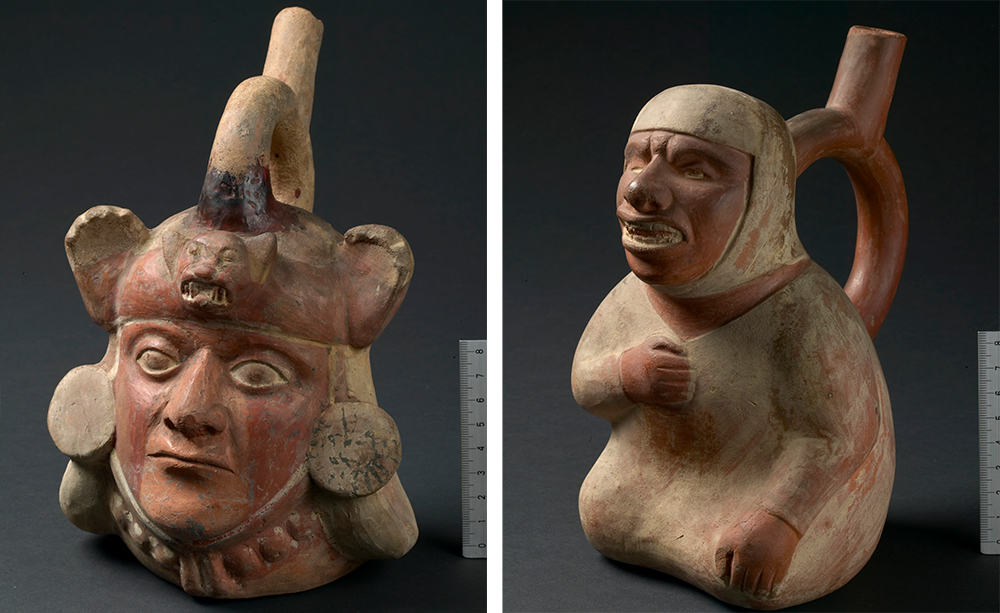
The South American collection at the Museum of Cultural History in Oslo contains a considerable number of pre-Columbian objects from the north coast of Peru. Originally grave goods, their naturalistic rendering of persons, animals, fruits etc. have since the 19th century made these ceramics particularly attractive for collectors.
Regarding the production of images as part of a shared religious system, the objects allow an insight into the relationship between technology, power, and belief. Thanks to archaeological research in the last decades, the images of the complex pantheon of the Moche society (100–800 CE) are now better understood. The ruling lords represented supernatural beings in rituals and were buried with the corresponding attributes. These lords had to face administrative and ritual tasks in an extreme environment. In the coastal desert, agriculture is only possible through an irrigation system, which was continuously challenged by El Niño events.
In her talk Manuela Fischer will touch upon both the history of collecting these objects and what they can tell us today.
About the lecturer
Manuela Fischer was the curator of the South American collections at the Ethnologisches Museum in Berlin (SMB/PK) until her retirement in 2023.
She had studied in Montpellier and Berlin, where she received her PhD at the Freie Universität Berlin with a study on ‘Regulation principles in the myths of the Kágaba, Sierra Nevada de Santa Marta, Colombia’ (1990).
As a curator she was involved in several exhibitions, most recently at the Humboldt Forum in Berlin (opening 2021). Her research interests are the history of science and the history of collections. She contributed to edited books, among others about the founder of the Ethnological Museum: ‘Adolf Bastian and his universal archive of Humanity’ (2007); ‘Max Uhle (1856-1944). Evaluations of his research and works’ (2010), about the historical archive in Berlin: ’Exploring the Archive. Historical Photography from Latin America. The collection of the Ethnologisches Museum, Berlin’.
Practical information
Kindly be informed that access to the seminar room requires a staff ID card. External guests will be greeted at the museum's main entrance at 14:45.