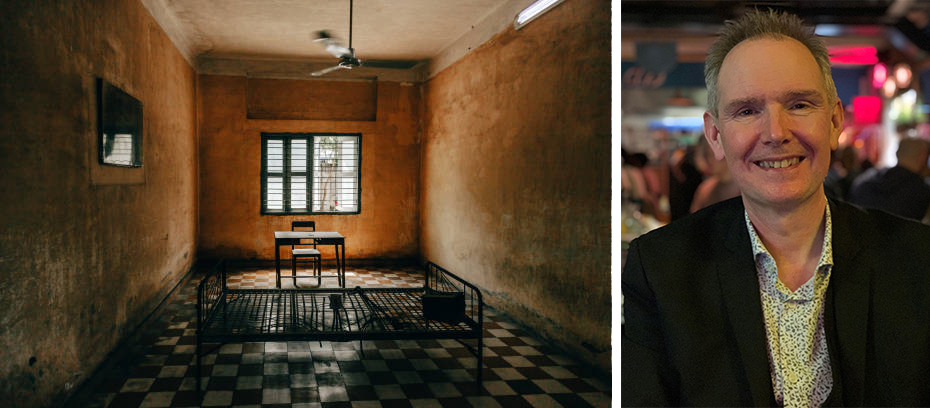
An increasingly popular tourist practice across the globe is visiting locations marked by past tragedies, including crime, war and punishment sites. The sheer diversity of sites associated with death and disaster is itself significant and has been the subject of a growing body of research. From the Alcatraz East Crime Museum and Jack the Ripper guided tours to the Cambodian killing fields, ‘dark tourism’ in now a multi-million pound global industry.
Although there is recognition that a dark tourism involves a ‘fluid spectrum of intensity’ (Stone, 2006:146) the museum experience is nevertheless central to it where representations of death, disaster or atrocity are displayed for an uneasy mix of education, commerce and memorialisation purposes.
The paper will take a closer look at the ‘museum effect’, which is produced through the interplay of objects, images and space, and is integral to how tourists encounter dark heritage. Crucially, it is achieved via a form of choreographed movement through institutional space, which combined with the allure of artefacts and practices, enables visitors to connect with a particular visualisation of the past. Critics have raised concerns over the ways in which leisure and pleasure are mixed with tragedy at the sites of dark tourism, and the paper will examine why the practice has been condemned as an inappropriate and immoral way to publicly commemorate human suffering.
About the lecturer
Eamonn Carrabine is a Professor in the Department of Sociology at the University of Essex, England. His books include Crime in Modern Britain (co-authored, 2002); Power, Discourse and Resistance: A Genealogy of the Strangeways Prison Riot (2004); Crime, Culture and the Media (2008); and Crime and Social Theory (2017).
He has published widely on media criminology, the sociology of punishment and cultural theory. The textbook he co-authors with colleagues from the University of Essex, Criminology: A Sociological Introduction, is now in its fourth edition. He is currently the Editor-in-Chief on the British Journal of Criminology and is writing a book on the Iconography of Punishment.