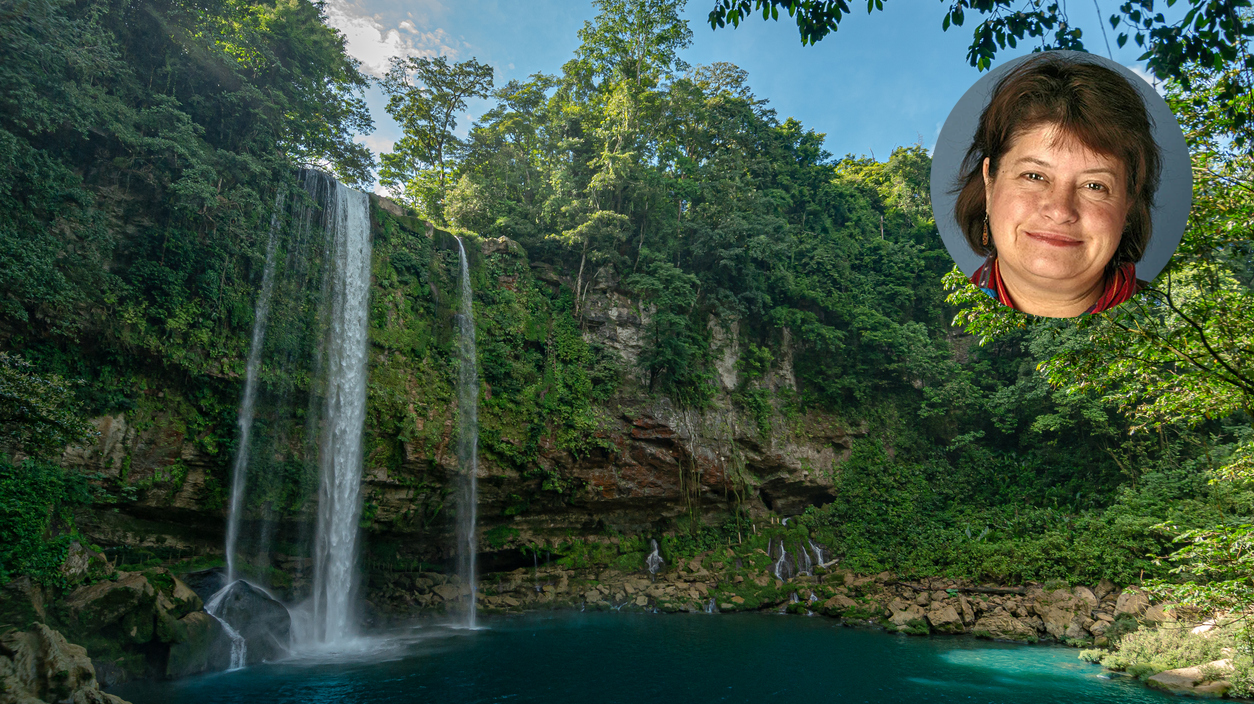
Indigenous communities aiming to protect their rivers and homelands often hope to persuade larger societies to recognize and respect the presence of ancestral water deities who personify the co-creative agency of water and the non-human domain. Such beings are ubiquitous in human history, and retain a central role in many place-based societies. Thus, water beings such as Rainbow Serpents in Aboriginal Australia, Māori taniwha, Central American plumed serpents, and the African deity Mami Wata, continue to exert substantial social and political power.
This lecture has two key aims: first, to suggest a broad comparative framework within which it is possible to consider the co-creative agency of water in riverine environments and, second, to provide a historical and ethnographic case study demonstrating how water divinities can elucidate such analyses. Drawing on museum objects, archaeology and ethnographic research, it considers the Mayan water beings that are venerated in Central America. Like other such figures around the world, these aquatic deities appear as creator beings in cosmic origin stories, provide the rain, generate life, and bring consciousness and enlightenment to humankind. Airborne feathered serpents and riverine water-lily serpents perform hydrological cycles between celestial and earthbound realms and, in describing the flows of water through the world, they also provide ways to envisage the movement of the human spirit between material and non-material domains.
The egalitarian and holistic visions of human and non-human creativity embodied by riverine water beings challenge anthropocentric assumptions about agency and the intellectual fragmentation of specialized and reductive analytic models. Manifesting at micro and macro levels, and connecting human and other living kinds in multi-scalar temporal, spatial, social and material processes, water beings offer radically alternate ways of thinking with and about water. In today’s political conflicts over water, including those in Central America, they provide powerful narratives through which indigenous and environmental activists can encourage societies to reconnect with riverine environments and re-imagine more reciprocal and sustainable human-non-human relations.
About the lecturer
Veronica Strang is Professor Veronica Strang FAcSS, an Environmental Anthropologist known for her long-term dedication to human relations with water. Professor Strang has long-term ethnographic experience from UK, New Zealand, and Australia, but also several other locations. She works with the water industry and many water using groups including indigenous people, farmers, miners, recreational water users, conservation organisations, museums and artists.
Amongst Veronica Strangs recent publications are: