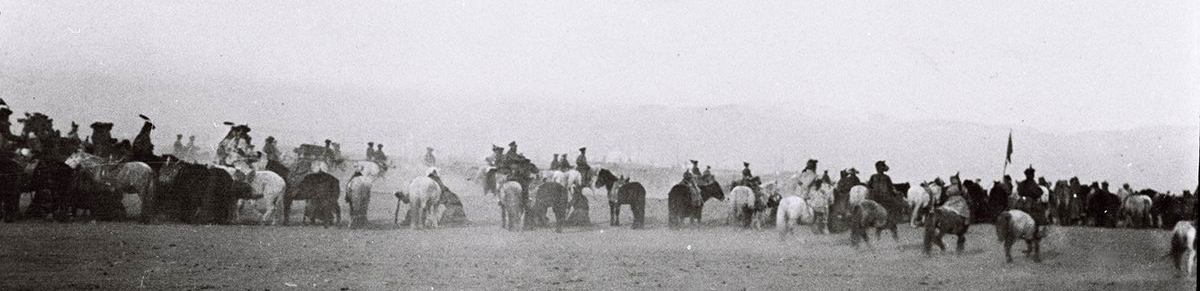
Mongolian independence, 1911
From 1691 onward, what is today known as Mongolia was part of the Qing Empire. The Qing successfully ruled both Inner and Outer Mongolia for 220 years by organising the Mongols into banners and encouraging Tibetan Buddhism. Beginning in the 1900s, Qing policy gradually shifted toward a more colonial approach. The Mongolian nationalist movement was growing, informed by the idea of establishing an independent nation-state.
During the summer of 1911, a Mongolian delegation travelled to St. Petersburg to seek Russian support for their independence. Russia promised economic and military support. When the Qing fell in October the same year, Gun Khaisan, a member of the Mongolian delegation to St. Petersburg, wrote to the Russian diplomat Kotwicz: 'The upheaval in the inner land provides an opportunity for Mongolia. We are going to seize it in order to engage in the great cause.'
However, when Oscar Mamen arrived in Mongolia for the first time in October 1911, Qing still held power there. The Mongolian nationalist movement was planning a coup d'etat to overthrow Qing rule. About a month after his arrival, on December 1 1911, the Mongolian declaration of independence was hung on posters throughout town. Shortly after, the first Mongolian government was established, with five ministries, a new flag and national anthem, and the introduction of the Mongolian lunar calendar. At the end of the year, Mamen witnessed the crowning of the eight Hutuktu, the living God-king, Bogd Khaan. He was now entitled 'Bogd Khaan – elevated by all', meaning he was the political and religious leader of the new nation state.


The Bogd Khaanate
In the following years, Mamen followed and documented the political events and development of the new country. He wrote detailed diaries, numerous letters and texts and took hundreds of photographs. To Mamen, Mongolians seemed enthusiastic and hopeful about celebrating their newly won independence, even though only Russia and Tibet had recognised it. A legal code was introduced, and educational institutions were established. Newspapers emerged, and scholars were hired to write the nation's history.
People gathered to participate in large public celebrations and rituals. Bogd Khaan was often in the centre of the events, as the primary symbol of the new state. A political pan-Mongolist movement blossomed to unite all Mongols. Barga and Inner Mongolians hoped to be included in the Mongolian state. Throughout 1912, Mongolians rode in from all directions to serve as soldiers for the new Mongolian army. The soldiers were trained by Russian military instructors who arrived with the military equipment. The soldiers participated in the 'five road battle' in 1913, which led to negotiations with China and Russia and, finally, the 1915 tripartite Kyakhta Treaty.


Religious life
Tibetan Buddhist rituals were an essential part of celebrating national independence in the 1910s. Often, there was a political aspect to the religious celebration, combining the worship of Bogd Khaan as both the political and spiritual head of state. During the lunar new year celebration, for instance, the Tsagaan Sar, Mamen describes a procession between the Winter Palace and the Yellow Palace similar to the coronation procession. At other times, such as the Tsam, including wrestling games and Buddhist dances, Bogd Khaan was present as a prominent guest and spectator.


Portraits
'Nothing beats a north Mongolian woman for luxurious style and colours in makeup and my eyes popped nearly out of my head when I unexpectedly came face to face with the first one I ever saw, I thought I met a Princess straight out of a fairy tale', wrote Mamen about Mongolian women dressed up on special occasions. In Urga, Oscar Mamen met the Mongolian nobleman Lobsan Jantsang and his wife, Altangerel. Lobsan lived in a large compound in the southern part of Urga with enough room to house Mamen and his commodities. Mamen and Lobsan became dear friends. They shared a love of the outdoors, hiking, hunting, animals, and guns.
Mamen later wrote about Lobsan: ''Lobsen Yantsang was his name, (…) a name very dear to me now. I did not then dream of the possibility that our lives should be linked together in the closest friendship and that I should see this man rise from rank to rank till he was equal to the highest nobles and still remain the same good Lobsen Yantsang.' At Lobsan Jantsang's houses, Rustad and Mamen photographed Lobsan's relatives, direct descendants of the great Chinggis Khaan, descendants of his youngest son Tuluy, according to Lobsan's great-granddaughter, Doctor of Historical Sciences N. Ariungua.


Urga architecture and landscapes
Mamen's photographs document several old buildings in Ulaanbaatar. Material and social change during socialist times, 1921-1990, and the later rapid urbanisation of Ulaanbaatar after democratisation have left the city unrecognisable from Mamen's time. In Mamen's photography, we can see the old temples, palaces, and districts, such as the Russian district with the consulate, post office, and the goldmine office Mongolor, the central markets, different streets, and houses in old Ulaanbaatar.


To Mamen, 'Mother Nature' was his kind of religion. Mongolia offered to Mamen endless camping and hunting possibilities. He describes countless flocks of animals surrounding the city. At times, he could even hunt from his house! In the mountains, he hunted wolves, marmots, roe deer, wild boars, geese, cram birds, partridges, snipes, turkeys, antelopes, and ducks. A short ride from his Urga home was the Tuul River, full of salmon. Mamen loved hunting trips with fellow Mongolians. Lobsan would almost always come with Mamen camping and hunting. The Mongolian landscape was magnificent to Mamen. It was a place to practice his kind of religion.


A collection in the making
Mamen stayed in Urga until 1915. Between 1915 and 1927, he lived with his first wife, Karen Oulie Hansen, and their two sons, Oscar Jr. and Odd, in Urga and in Tianjin, China. Karen, Odd, and Oscar left Mamen in 1927. In 1928, he went on several field trips to the Ewenki reindeer herders in Inner Mongolia with his second wife, Cambridge anthropologist Ethel Lindgren. They married and had one son, John Lindgren. Mamen moved back to Norway as his second marriage ended. The collection from Mamen's years with Lindgren is cared for at the Museum of Archaeology and Anthropology in Cambridge, England.
After his second divorce, Mamen wrote a manuscript about his first years in Mongolia, called 'Going East' (published in Ulaanbaatar in 2022 (Mongolian version) and online in 2025 (English version). Mamen returned to Inner Mongolia in 1937 as an ethnographic object collector. He authored a second manuscript about this trip, called ‘Another year in the East’ (published in 2024 in English). In 1938, he left Asia to settle in Tanzania as a game manager. His first wife, Karen, joined him with Oscar Jr., and they remarried. Mamen spent the rest of his life in Africa with his family and three grandchildren. From these years, there are several hours of 8 mm film captured by Mamen. He went back to China once as a soldier for the British forces during World War II. Oscar Mamen died in a car accident in Dar Es Salaam in 1955. In 2017, Mamen's Norwegian grandchildren donated the Mamen collection to the Museum of Cultural History for research. 7620 photographic negatives were digitised.


Researching the Mamen collection
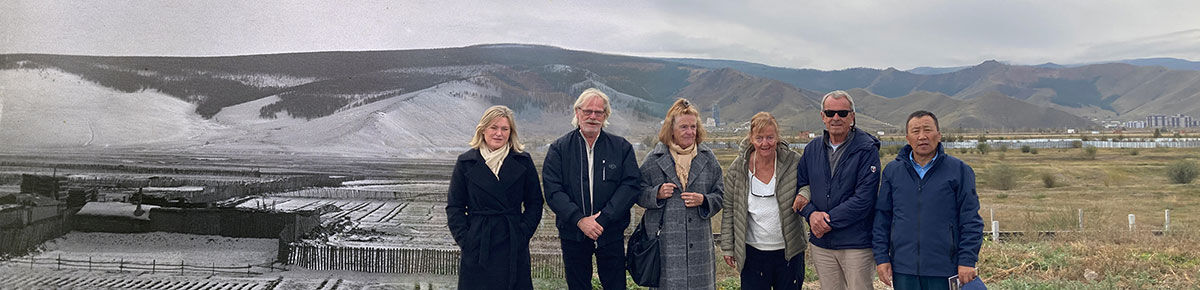
In 2019, anthropologist Maria Kartveit started her doctoral project to return Mamen's photographs to Mongolia. For five years, she collaborated with S. Chuluun, director of the Chinggis Khaan National Museum, J. Erdenebat and J. Lkhagvademchig from the National University of Mongolia, O. Batsaikhan at the Mongolian Science Academy, and A. Bolormaa and N. Otgonbat at the National Art Gallery of Mongolia. The project resulted in several books, articles, conferences, and photography exhibitions.


Present-day Ulaanbaatar was known to European and Russian travellers as ‘Urga’. In Mongolia, the city was called Ikh Khüree from 1706 to 1911, when the city was renamed Nijslel Khuree. In 1924, the city was renamed Ulaanbaatar, meaning ‘red hero’. This page follows Mamen's naming practice, using 'Urga' for Nijslel Khuree.
Acknowledgements
This text is based Maria Kartveit's doctoral thesis, 'Transcending Imagery: An Anthropological Study of Oscar Mamen’s 1911–1913 Photographs and their Circulations in Mongolia', University of Oslo, 2025. Request a copy of the thesis.
Thanks to the Lobsan, Mamen and Lindgren families, President U. Khürelsükh, former President K. Battulga, Ambassador T. Janabaza, S. Chuluun, O. Batsaikhan, T. Khongorzul, U. Tsultem, Togtokhbayar, J. Lkhagvademchig, J. Erdenebat, A, Bolormaa, N. Otgonbat, J. Urangua, Jocelyne Dudding, Yuki Konagaya, Mitsuko Watanabe, Sue Byrne, and the International Association for Mongol Studies for collaboration and advice.
Explore
- Mamen's photographs from Mongolia
- Artifacts collected by Mamen and Lindgren in Mongolia and Inner Mongolia
- An overview of Mongolian cultural heritage at the Museum of Cultural History
- 'Going East', foreword by Maria Kartveit. Mamen's manuscript was written in the 1930s. Available at the bookshop at the National University of Mongolia in Ulaanbaatar. In Mongolian.
- 'Treasures of Mongolian Cultural and Historical Heritage in Norway'. Ulaanbaatar: The Chinggis Khaan National Museum, 2024. In English/Mongolian.
- 'Another year in the East'. Digitised by the Norwegian University Library, 2024. In Norwegian.
- 'Photographing Change: Oscar Mamen in Mongolia 1911 to 1915'. In Chinggis Khaan Journal, Ulaanbaatar: Chinggis Khaan National Museum, 2023. By Maria Kartveit. In English.
- 'Mongolia and Mongols Volume X'. Ulaanbaatar: International Association for Mongol Studies, 2022 By S. Chuluun and Maria Kartveit. In English/Mongolian.
- 'Book review on "Travelling to the East" - Oscar Mamen's note on the Bogd Khanate' Journal of International Studies, 45(114), 136–154, 2022. By O. Batsaikhan. https://doi.org/10.5564/jis.v45i114.2468. In Mongolian.