Originally Captain Arup collected objects on the island. In 1878, the Museum Director Yngvar Nielsen exchanged seven of the collected artifacts with the Godeffroy Museum in Hamburg in order to acquire artifacts from other part of the world that, in Nielsen’s opinion, were not well represented in the University’s ethnographic collections. Today, six of these objects are located in the ethnographic collections of GRASSI Museum in Leipzig in Germany.
The small collection and the circumstances which brought Peter Arup to Rapa Nui and some of Rapa Nui’s objects to Norway at the other end of the world tell a story about both the history of Rapa Nui and of Norway.
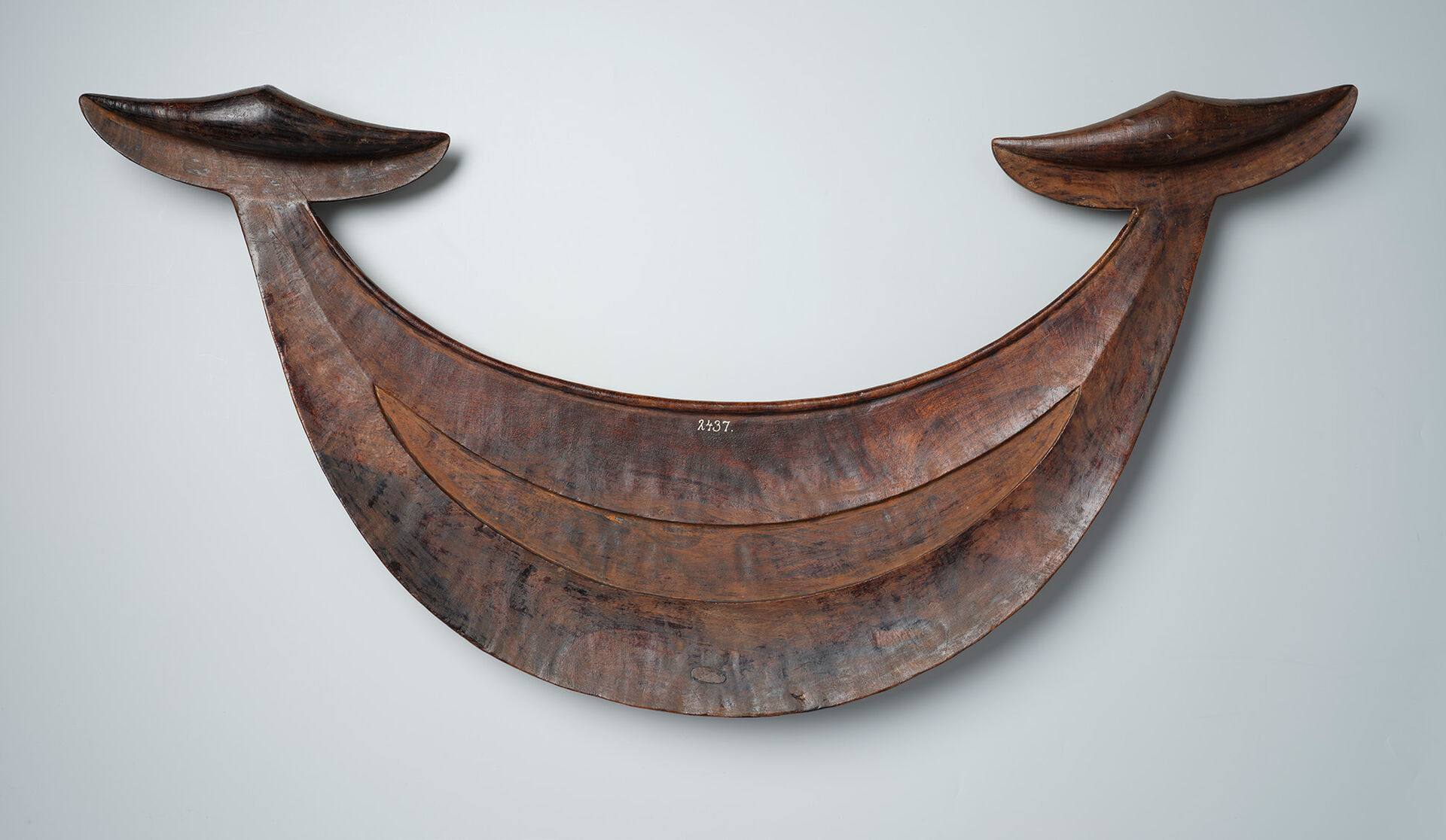
(UEM2437) Reimiro breast ornament
(UEM2437) Reimiro breast ornament carved in brown hardwood measuring 93,5 centimeters. It was carved out of an unidentified kind of wood but most similar breast ornaments were probably carved from makoi wood (Thespesia populnea) or toromiro wood (Sophoro toromiro) where the trunk branches out toward the crown of the tree.
The Reimiro is sickle shaped (or lunate) with carvings at both ends of the board possibly representing either giant shells or the tails of whales about to dive.
Carvings of this type are relatively rare and twice as many of the known Reimiro breast ornaments from Rapa Nui in stead have carvings of human profiles at each end of the board. Four holes at the upper part of the backside of the board make it possible to carry the Reimiro in a string around the neck and such ornaments were quite likely worn by Rapanui aristocrats during ceremonial dances.
Lunar phases were very important in Rapanui agriculture in connection with both the planting and harvesting of root crops and the resemblance between Reimiro boards and the moon sickle have made some experts on Rapanui culture relate their use to rituals connected to the agricultural cycle. Others have by comparing the shape and carvings of the Reimiro breast ornaments with petroglyphs representing the smiling god Makemake discovered in Orongo argued that the breast ornaments represent the broad grin of this Rapanui deity.
The words rei and miro simply signify ‘necklace of wood’ and we don’t know the final answer to the question of its role in ancient Rapanui society. It is very likely however, that just as the Ua staff and the Ao staff its use was exclusively for people of very high rank and probably linked to their role in connecting the sacred domain of the gods with the mundane domain of ordinary humans.
In today’s Rapa Nui such breast ornaments are considered a very important part of cultural heritage and a representation of a Reimiro ornament decorates the flag of Rapanui. Of the 40 breast ornaments of this kind that have been registered in private and public collections this Reimiro is the largest one.
(UEM2441) Tahonga pendant
Tahonga pendant carved from a single piece of brown hardwood with a height of 11,5 cm and a circumference of 31,7 cm. The pendant is of oval shape and has four equally large sections separated by ridges in low relief and two holes at one end for attaching a string by which it is possible to hang the pendant around the neck or elsewhere.
Surviving Tahonga pendants have varying carved decorations but have all in common their slightly oval shape and their separation into three or four equally large sections separated by ridges carved in low relief emerging from a common point and surrounding two holes for attaching a string making it possible to carry the Tahonga around the neck at ritual occasions. Tahonga pendants have no equivalent anywhere else in Polynesia but are quite unique for Rapanui woodcarving art. Because of their shape they have been interpreted to represent coconuts and human hearts as well as eggs. In their examination of Rapanui material cultural heritage, Treasures of Easter Island (Editions D et Editions Louis Leiris, 2008), Michel and Catherine Orliac conclude that in spite of the fact that their shape, size and color make them look rather like coconuts, they were probably not intended to represent coconuts because coconut palms no longer existed on the island at the time when Tahonga pendants were carved. Before human settlement Rapanui was covered with palm trees but they became extinct a few centuries after settlement, possibly through a combination of intensive use and the introduction of palm rats accompanying the first human settlers on Rapa Nui. According to Orliac both their almost exact similarity in shape when compared with eggs of the seabird Black tern, the important role of bird representations in Rapanui rituals and the significance of the egg in Polynesian myths about the world’s creation, make it most likely that Tahonga pendants lend their shape from the egg. In that case the ridges carved in low relief which separate the sections of the pendant might represent cords supporting and nestling the egg and transforming into a real cord for suspending the Tahonga when worn around the neck or hung elsewhere. Out of the 23 Tahonga pendants known to have survived in different collections of artefacts from Rapa Nui, the particular Tahonga Peter Arup brought to Norway after visiting Rapa Nui in 1869 was the second one to be collected from the island.
(UEM2436) Ao command staff
Ao command staff measuring 1,49 meters made from brown hardwood. It is carved out of the core wood of a single piece of an unidentified tree species and consists of two broad and flat paddle shaped blades connected by a narrow, cylindrical shaft. The blade which made up the top of the staff at occasions of use is shaped like a human face under a high and somewhat square forehead with carved representations of eyes, nose and ears and earlobes seemingly extended by cylindrical ornaments. The blade making up the lower end of the staff terminates in a cylindrical phallic appendage with a transvers rib marking what may be considered the penis head.
Eleven similar staffs from Rapa Nui are known, 8 of which have carved faces on one of the blades and 3 of which have eyes, nose, mouth and ears painted onto them. Ao staffs have much in common with the much shorter Rapa staffs from Rapa Nui but in contrast to these were probably not used at dance performances. The word ao itself signifies both ‘to command’ and ‘power’ and was probably a forceful symbol in the hands of persons of authority and high rank in Rapanui ceremonial life for example during the so called Bird-man festivities in Orongo where most of the petroglyphs depicting staffs of this kind have been discovered. The length of the Ao staffs, sometimes exceeding the length of a human body, and its penis shaped appendage at the lower end, have made experts on Rapanui culture such as Michel and Catherine Orliac interpret the staff as a kind of ritual tool grounding the person who wielded them in the earth and connecting the sacred forces of the earth below with those of the sky above, a theme which was very common and quite central in pre Christian cosmology throughout Polynesia.
(UEM2438) Moai tangata manu figurine
Moai tangata manu figurine measuring 32 centimeters in length carved out of the root of a tree. The figurine represents a blend of bird and man where anthropomorphic human facial traits transform into a bird’s beak and where folded wings are suggested along the body of the figurine. This Moai tangata manu figurine was probably longer originally and with eyes consisting of rings of bird bones surrounding obsidian irises. According to Adrienn Kaeppler it is not uncommon that figures from Rapa Nui lack eyes either because they had fallen out before being collected and were thus considered ‘destroyed’ by their owners or because the figures were ‘deactivated’ or had their sacred force removed before being handed over to foreigners.
On Rapa Nui birds inhabiting the gap between heaven and earth were considered the messengers of the gods and as a blend of the shape of humans and birds it is possible that Moai tangata manu figurines were a sort of ritual tools to engage sacred forces. Many petroglyphs representing blends of the shape of humans and birds have been discovered in Orongo on Rapa Nui (370) but only a handful of such blends in the form of wooden figurines have survived. Apart from such Moai tangata manu representations, figurines with marked masculine (Moai tangata) and feminine (Moai vie) characteristics, figurines representing emaciated ancestors with very marked ribcages (Moai kavakava) and representations of beings exhibiting a blend of the shape of humans and lizards (Moai tangata moko), are very characteristic of Rapanui sculptural woodcarving.
(UEM2445) Oblong figurine/pendant
Oblong figurine/pendant carved from a piece of brown hardwood with a length of 14,7 cm. and a width of 7,6 cm. A hole through which a plaited cord is attached has been drilled through one of the figurine’s edges.
Upon Arup’s return to Norway in 1871 the figurine was catalogued as s “turtle figure” but both its elongated shape and the highly naturalistic carving of the figurine’s back plate indicate that it represents a kind of marine mollusk/chiton inhabiting the sea around Rapa Nui. The hole through one of the edges and the string attached to it indicate that the figurine just like UEM2443 and UEM2444 could be carried around the neck either alone or as part of a pair of pendants during ceremonial performances on Rapa Nui.
(UEM2443) Gourd shaped figure/pendant
Gourd shaped figure/pendant carved from brown hardwood measuring 7,5 cm in height and with a circumference of 20,5 cm. The gourd pendant is decorated with a carved animal figure (probably a moko/lizard) on one of the sides and has two holes in a slightly protruding nipple inside the “bottleneck” of the gourd.
Out of five known similar gourd shaped figures this is the only one with a carved decoration. The two holes in the nipple within the “bottleneck” makes it possible to carry the figure in a string around the neck as a pendant and this was probably done during ceremonial dances. It is also possible that the string passed through the holes was used to attach the gourd figure to a Tahonga pendant (see UEM 2441) so that the two constituted a united pendant pair at ceremonial occasions. Thus according to Michel and Catherine Orliac a gourd figure and a Tahonga pendant from Rapa Nui were still attached to one another by a string when acquired by the British Museum in 1870 (6817 a og b).
(UEM2444) Figure/Pendant
Figure/Pendant carved from a single piece of light brown hardwood shaped like the head of a bird, fish or turtle measuring 12,0 cm in length and 6,0 cm in height. The top of the head is decorated with what appears to be a carved turtle. Two holes have been drilled at one of the ends making it possible to attach the figure to a string.
Few figures like this from Rapa Nui have survived but a similar figure acquired by the Russian explorer and adventurer Miklukho Maklai in 1871 which is referred to by Michel and Catherin Orliac as a bird’s head figure was at the inclusion in the Kunstkamera collection in St Petersburg attached with a string to a Tahonga pendant so that the two made up a pair (402-201 a-c) which thus like other known pairs of pendants (see UEM 2443) could have been worn around the neck at ceremonial dances on Rapa Nui. Many petroglyphs depicting turtles have been found on Rapa Nui and the carving apparently depicting a turtle on the top of the carved head may indicate that the figure represents the head of a turtle rather than a fish or bird.
(UEM2435) Ua staff
Ua staff measuring 0,93 meters made of brown hardwood with carved anthropomorphic janus faces at one end with a human tooth lodged into the top of the staff. The eyes consist of white circles made out of bird’s bone surrounding irises of black obsidian.
About 60 similar staffs from Rapa Nui are known. This particular Ua staff is the only of these with a human tooth lodged into the top of the carved janus head of the staff. It is about 50 centimeters shorter than most other staffs of this kind and it may appear to have been longer originally but to have been shortened and repaired due to tear and wear prior to being collected. Ua staffs from Rapa Nui were not intended for daily use or as weapons even though both their weight and hardness would make such use possible. They are often referred to as “insignias of authority/dignity” or “chief’s staffs” because persons with authority or high rank carried them on important political and ceremonial occasions.


Peter Arup on Rapa Nui

Peter Arup was born in 1840 in Norway’s capitol Christiania and became «skipper citizen of Christiania» when he was 26 years old in 1866. Shortly after that he was hired as skipper on the Brig Glitner, a 232 ton sailing ship. In 1849 Brittain had repealed its old Navigation Act hindering other than British merchant ships from carrying goods between Europe and the British colonies. Peter Arup and his elder brother Thorkel Arup used the new window of opportunity that this opened and together bought 3/16 shares in Glitner. After having freighted timber from Bourdeux in France to the swiftly growing city of San Francisco in California in 1868, Arup acquired a new cargo of timber from San Francisco to Valparaiso in 1869. On November 10th in 1869 he wrote a letter to “colonial merchant” A. Hesselberg in Christiania, who was Glitner’s major shareholder that he had secured an unexpected freight mission of taking “French Jesuits” and their belongings from Valparaiso to «Easter Island» where a French Catholic mission had recently been established. On December 2dn in 1869 Captain Arup delivered the missionary Father Gaspard Zuhmbom to the Catholic mission station on Rapa Nui. For how long Arup remained on Rapa Nui we do not know, and it is also unknown whether he acquired the artifacts directly from indigenous Rapa Nuians or through French intermediaries with better knowledge about Rapa Nui and its culture.
Rapa Nui in 1869
Polynesian people had been living on Rapa Nui for several hundred years when the Dutch explorer Jacob Roggveen and his crew who were the first Europeans to visit the island arrived in 1722. Like other European explorers he was not very concerned by what the places they «discovered» were called by the indigenous people living there and because he first sighted the island on Easter Sunday, Rapa Nui became known as Easter Island in Europe. Today Rapa Nui is the island’s official name.

140 years after the first European arrival, in 1862, slave traders from Peru, the so called «blackbirders», raided Rapa Nui and killed or abducted half of its population estimated to around 3000 people to ship them back to South America and sell them as slaves on plantations there. The French Bishop on Tahiti further North in East Polynesia contributed to raise a public opinion in Europe against these atrocities which in the following year forced the plantation owners to set free the few slaves from Rapa Nui who had not already succumbed to dysentery, tuberculosis and measles. As the French missionaries established their station on Rapa Nui in 1864, the returned slaves brought back the new diseases to the island. In the epidemic that resulted an additional 300 people were killed including Manu Rangi, Rapa Nui’s Royal heir (Ariki mau). Of the 3000 people that had lived on Rapa Nui before the raids in 1862, only about 930 remained when Arup visited the island a few years later. The fact that more than 2/3 of the population in a few years had been either killed by slave traders or succumbed to new diseases represents a backcloth for the rapid conversion to Christianity immediately prior to Arup’s visit and perhaps a failing faith in the power of the sacred beings many of the objects Arup collected were related to.
Rapa Nui today
Rapa Nui is today a part of Chile and many of the island’s indigenous people living in the periphery of a nation dominated by people with other cultural traditions are very concerned about their unique cultural heritage and their strong ties to their free and independent Polynesian ancestors. History has taken a large part of their cultural heritage away from the island, first of all to national historical collections in Chile’s capitol Santiago and to collections in the Vatican related to Catholic missionary work, but also to the many places more coincidental visitors like Peter Arup have brought them. Both the historical collapse European contact created on Rapa Nui and the need to experience cultural pride and belonging as an indigenous people that the current minority situation creates, make the cultural heritage objects that have survived Rapa Nui’s brutal encounters with imported supremacy culturally highly valued and a uniquely important link to the past.

Explore further
In 1907, the director of today's Museum of Cultural History, Yngvar Nielsen wrote about Peter Arup's travels and collecting: