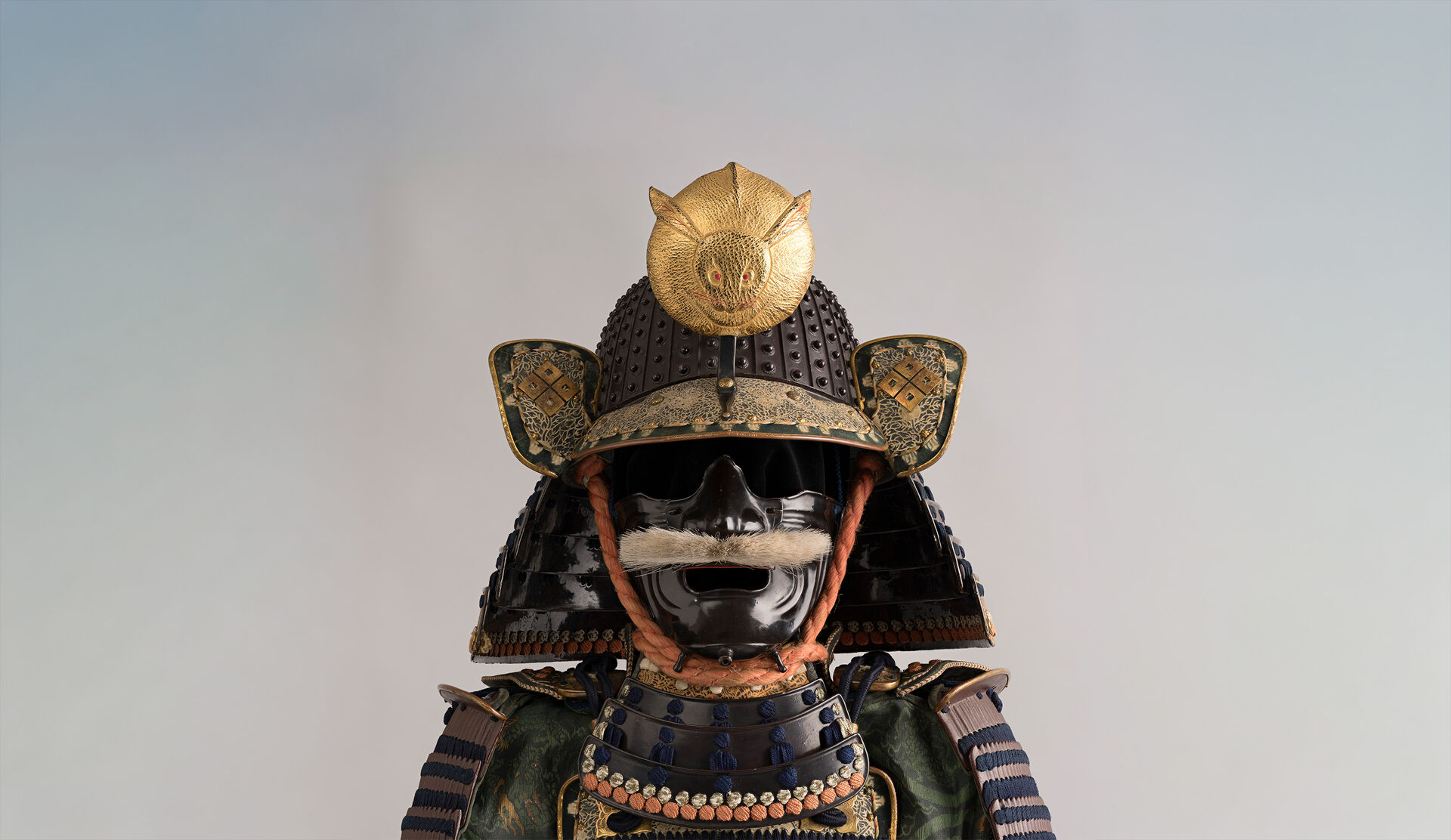
The helmet of the armor stands out with its construction. It consists of 32 plates; each has 13 rivets that stand out and have flower shaped washers at the base. This is called hoshibachi, which translates to a helmet bowl with stars.
The rivets were mainly for decorative purposes but also gave a certain reinforcement. On the deflectors on the neck guard there are gilt family devices, mon, in the shape of four squares. The helmet crest in front, maedate, is in the shape of a gilt hare with red eyes. In Japan the hare was a symbol of speed into battle and the ability to have many children.
The hands have the same mon as the helmet. This is called yotsume, “four eyes”, and was used by several samurai families, some of them of daimyo rank.
Helmet, kabuto
Made of 32 identical triangular plates meeting at the top in a small hole, tehen. Each plate is fastened with rivets, 13 in each plate, all with a flower shaped washer around the base and with rounded heads. The style is called hoshibachi no kabuto, or helmet bowl with stars. Lacquered in dark brown (almost black). The peak is covered in stenciled leather and has an iron holder for a helmet crest, maedate. On the top, surrounding the hole there is a five-tiered mount, tehen kanamono, in alternatively brass and copper.
Neck guard, shikoro: Made of five iron plates, outside lacquered sabi nuri, the inside and the outside edges are glossy. The plates are held together with dark blue laces set in pairs, and the lowest lacquered in pattern of gold on a background of sabi nuri. The upper plate of the shikoro is turned up at the ends in front to form deflectors, fukigaeshi. Like the peak, the deflectors are covered in stenciled leather, both have a brass, possibly gilt, heraldic device, mon, made up of four squares with square cutouts in the middle. In Japanese this figure is called yotsume, meaning “four eyes”.
Helmet crest, maedate: The crest is made of pressed and gilt leather in the shape of a hare (usagi) seen from the front, with red eyes and details. The inside is lacquered red.
On the lacquer: The helmet, the mask including the throat guard, and the chest and back of the cuirass is lacquered glossy, with a perfectly smooth, shining surface of carefully laid urushi lacquer. All other iron plates (part of the neck guard, shoulders, arms, skirts, shins) are matte, by sabi nuri. Sabi nuri is urushi lacquer mixed with a material that gives a rust-like effect. Sometimes iron filings were used, in which case the “rust” is actually rust, even though it is not the material underneath that is rusting. Other times, other substances have been added to the lacquer, such as black tea or clay.
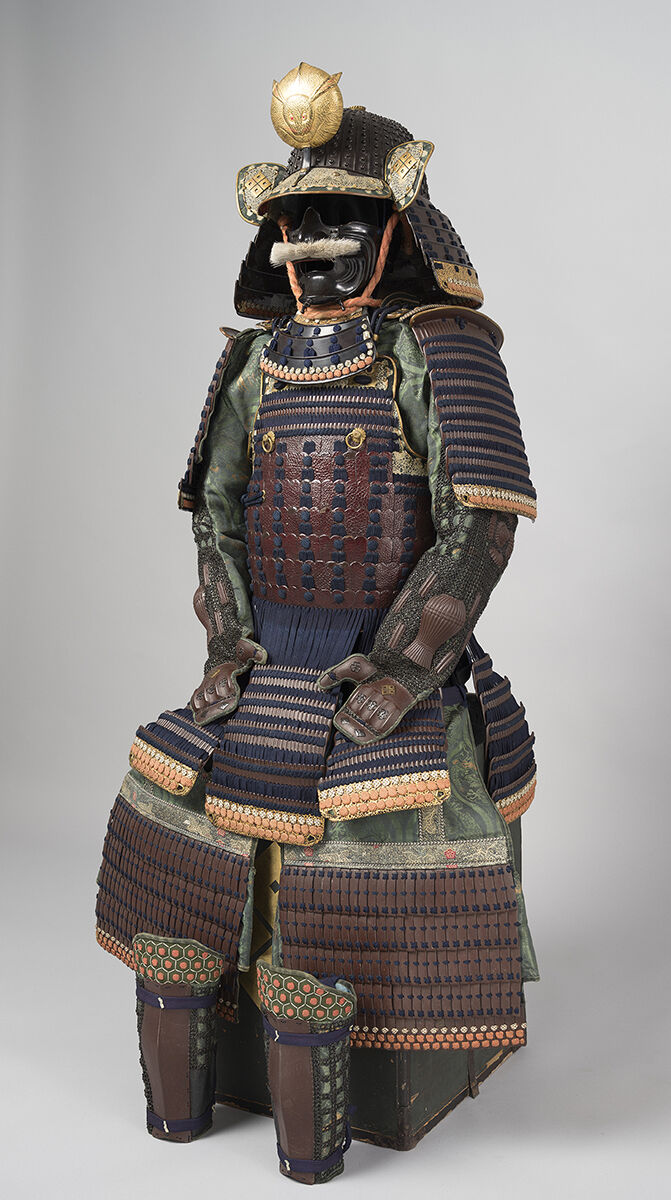
Mask, menpō
Iron, black lacquered with a large white mustache, lacquered red on the inside and on the upper lip. The throat guard of three black plates has blue lacing, the lower plate with a multicolored braid.
Cuirass, dō
In two parts, hinged on the left-hand side, of the type called nuinobe-dō, made of iron plates covered with leather, then lacquered shiny brown. The plates have a wavy upper edge and are held together with dark blue braid spaced in pairs on each plate. The upper part of the cuirass is decorated with stenciled leather. On the breast plate there are two brass rings on flower-shaped washers. These attach the saihai, the commander’s baton, and a scarf. Buttons and fittings are gilt copper with engravings.
Tassets, kusazuri: In seven parts, each consisting of five brown lacquered iron plates, laced in dark blue. The lower plate is covered in the same pattern of gold lacquer as the neck guard and has one row of multicolored and two rows of red braid. The front tasset has a pocket on the inside which follows the tasset shape, made of blue cotton textile with a horn button for closing.

Shoulder guards, sode
Of medium size, seven sabi nuri lacquered plates, with blue lacing, the lower end with gold lacquer and multicolored and red braids in two rows. Engraved, gilt copper fitting on the protruding part at the top. Blue cotton textile lining.
Arm guards, kote
Chainmail with sabi nuri lacquered plates, gourd shaped ones on the upper and lower arm, a rosette shaped plate on the elbow. Mounted on brocade with dragon pattern. The hand has separate thumb and lower shaped lacquered ornaments and the same gilt mon as on the helmet. Blue cotton textile lining.
Skirt, haidate
5 x 25 plates on each part, sabi nuri-lacquered, laced with dark blue laces, red and multicolored on the lower plate. Mounted on brocade, stenciled leather details, blue cotton textile lining.
Shin guards, suneate
Made of sabi nuri-lacquered iron plates with a vertical bend in the middle. Arranged in columns with three plates in each column. Mounted with chain mail on green brocade and with gold-lacquered leather on the inside of the leg. Blue cotton lining.
Box, hitsu, number UEM41988
The armor comes with its original armor box with the mon painted in gold.