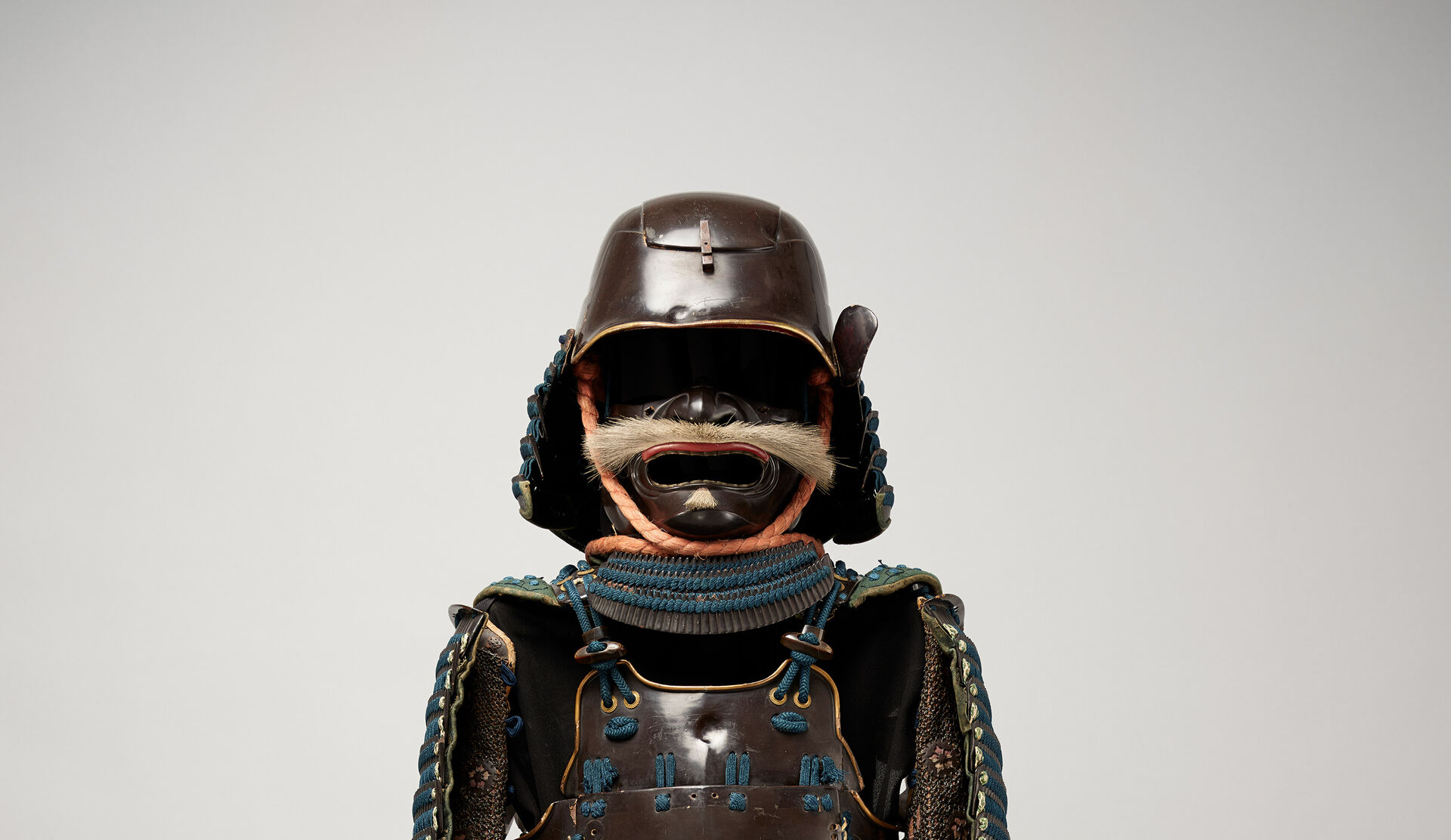
The cuirass has three dents, two in front, one at the back, after being shot at with musket balls. The practice of testing elements of armor became fashionable when matchlock muskets came into use in the 16th century.
The family crest, mon, is called “seven stars” and was used by a large number of samurai families.
The armor is complete, but in the skirt and the shin guards no aesthetic elements from other parts of it have been picked up, suggesting that they may not originally belong to it.
Helmet, kabuto
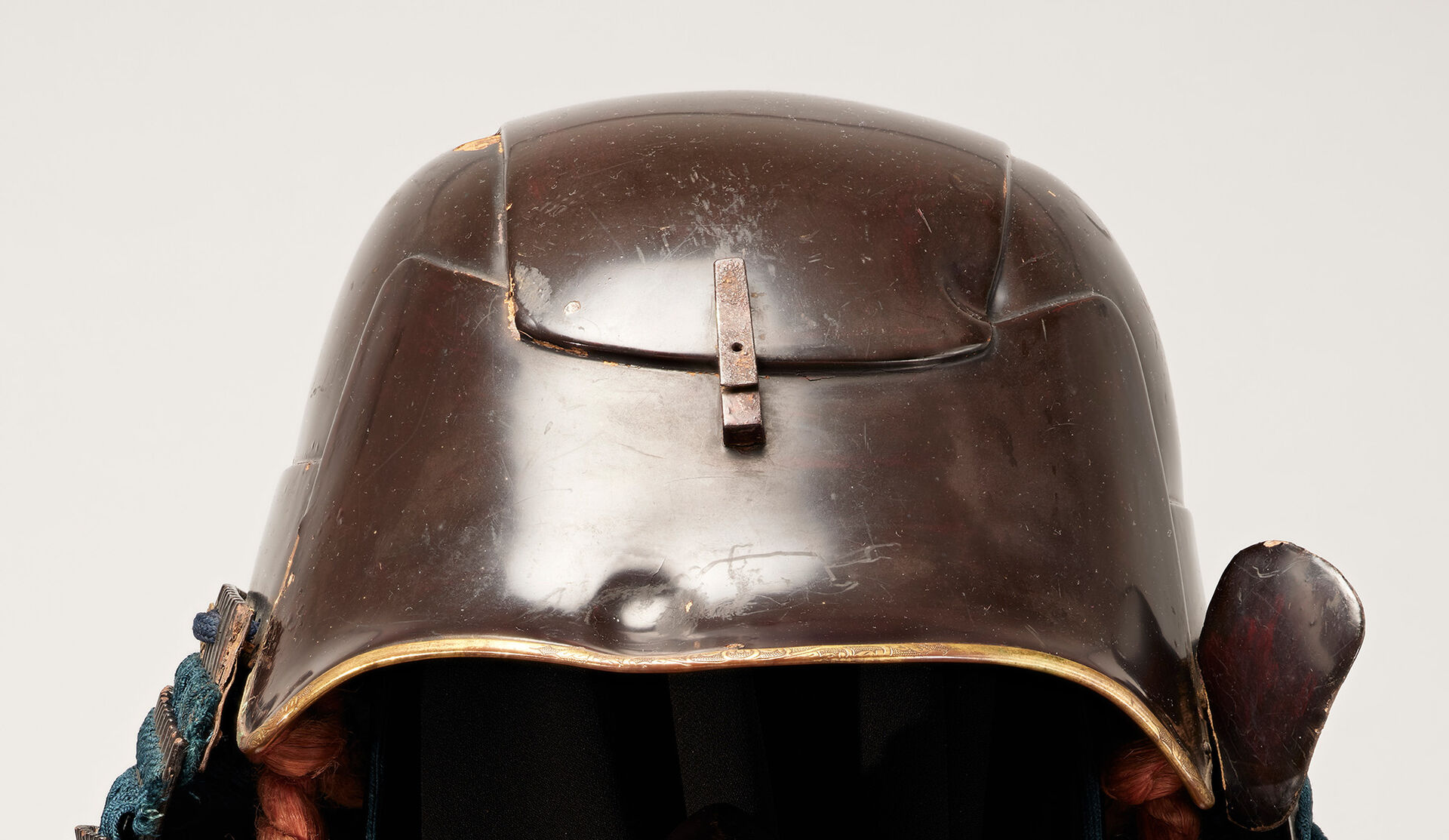
Head shaped type, known as zunari. Lacquered dark brown with a narrow strip of partly embroidered brass on the mabizashi, the peak. Neck guard, shikoro, of five dark brown lames, laced in blue. The upper lame is extended and turned back into small deflectors, fukigaeshi, one of them detached but present.
Three of the plates of the helmet bowl have dents after gun shots, done for testing purposes.

Mask, menpō
With a fierce expression, ressei men, lacquered dark brown with a big white mustache and a small goatee beard. The upper lip is painted red, the mouth has silver plated teeth. The inside of the mask is lacquered red.
Throat guard, shikoro, is made of four plates black lacquered with blue lacing.
Cuirass, dō
In five parts, hinged on the left-hand side. In addition to the breastplate and the backplate there is a small plate on the left side of the opening and two small plates on the right-hand side. All lacquered dark brown.
The breastplate consists of five horizontal plates with a ridge along the middle and fastened at the top to a plate with room for the neck. The back plate has a similar construction with horizontal plates.
The breast plate has two dents from musket balls, one at the top and one at the bottom, the back plate has one such mark.
Tassets, kusazuri: Seven tassets, each of five plates, dark brown with blue lacing.
Shoulder guards, sode
Medium size, made of seven dark brown plates with blue lacing, the lower plate with multicolored braid.
Arm guards, kote
Made of chain mail with applied iron plates and a rosette shaped plate on the elbow. The hands are iron plates with embossed decoration of a heraldic device, mon, in the figure of six round dots surrounding a seventh, all mounted on brocade. Unlike the rest of the armor, the iron plates on the arm guards are not lacquered glossy, but matte, sabi nuri (the sabi nuri process involves applying layers of urushi lacquer mixed with iron filings or iron oxide powder to create a matte, antique, rust-like finish).
There are no aesthetic elements or material choices from the rest of the armor that remain in the sleeves, suggesting they may have been picked from another armor.
Skirt, haidate
14 dark lacquered plates in each of four rows mounted on green brocade. Few aesthetic elements from other parts of the armor is picked up in the skirt, suggesting it may not originally belong to this gusoku.
Shin guards, suneate
Each shin guard has four vertical iron plates connected by chainmail.