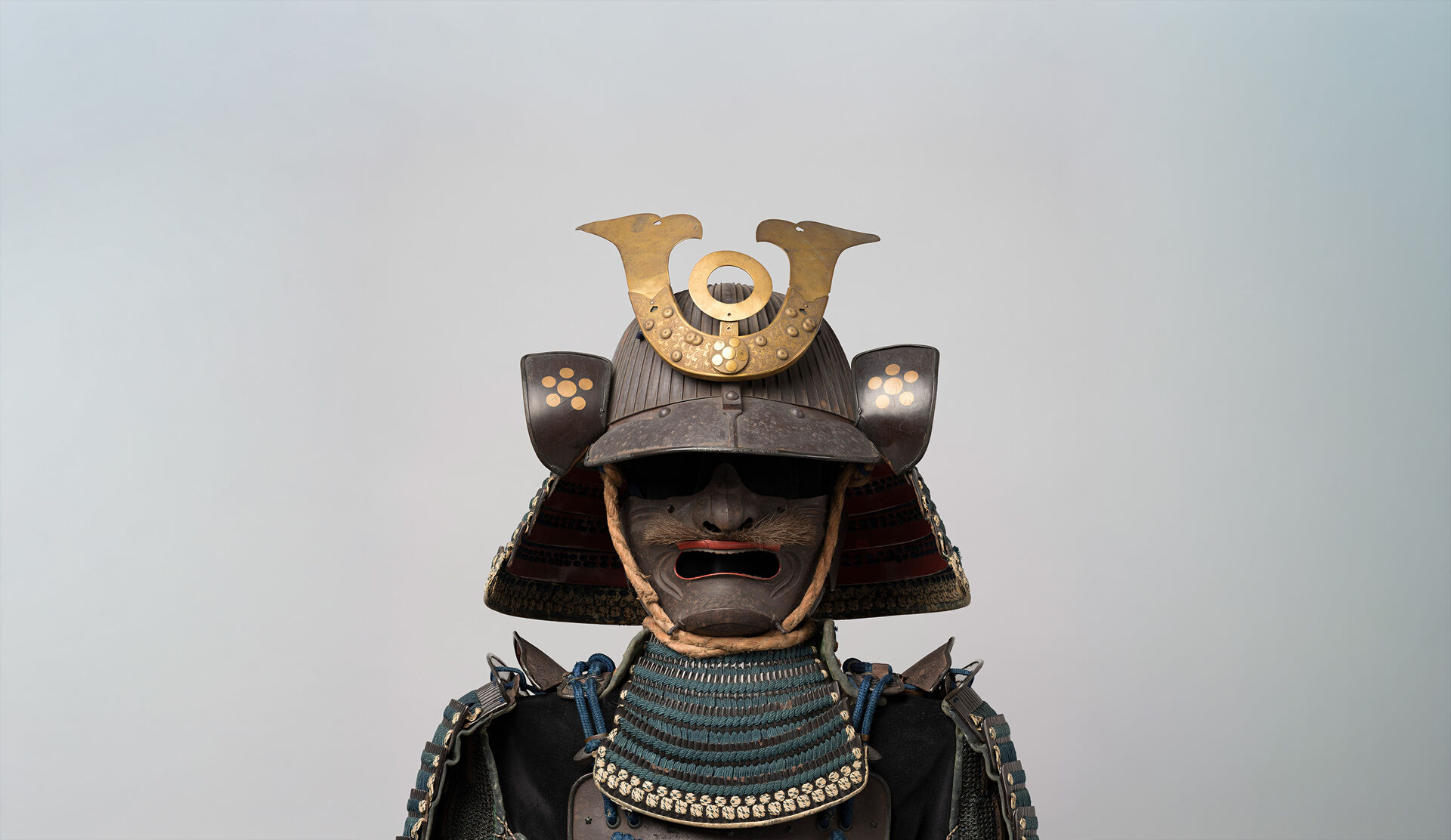
There are two mon, or family crests, on the various parts of the armor. One is made of five round dots around a sixth – in Japanese called six stars, Hoshi – and the other mon with the water plant, Omodaka. Both are used by several families, but with the two appearing together it is quite likely that this suit belonged to a member of the Matsudaira clan. The Matsudairas were closely related to the Fujiwaras, in reality the same clan.
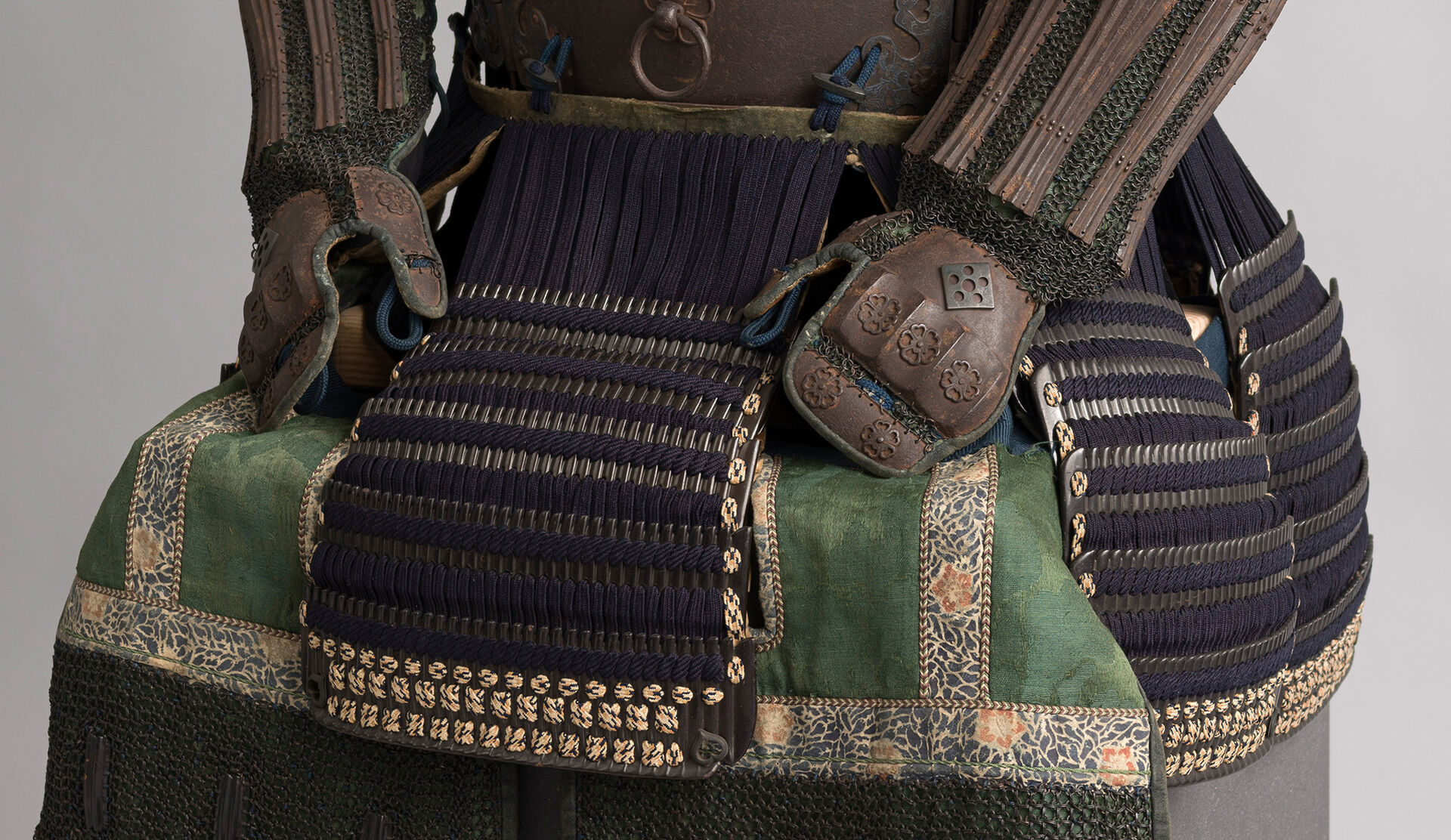
The medicine boxes on the sleeves appear to be an invention of the famous 17th C. armorer Noguchi Zesai.
Helmet, kabuto
The helmet bowl of 62 plates with flanges, suji, the type is called sujibachi no kabuto. The plates meet around a small hole, tehen, which is surrounded by a small iron mount, tehen kanamono, in three layers. The surface is russet, sabi nuri (layers of urushi lacquer prepared to create a textured, antique, rust-like finish). The peak, mabizashi, has a narrow, engraved metal (probably copper) rim and an iron crest holder.
The neck guard, shikoro, is of black lacquered iron bands, in four parts laced with alternatively dark blue and dark green braid. The uppermost band turns up and out into defectors, fukigaeshi, black lacquered with gold heraldic crests, mon, in the shape of five round dots around a slightly bigger, sixth one. The nails fastening the uppermost plate of the shikoro to the helmet bowl are in shakudō (an alloy of copper and gold) decorated with the same mon.
The back of the bowl has a gilt copper ring with a cord, agemaki, tied in loops, and the helmet retains its original fastening cord.
The lining is intact but loosened in one spot enabling a view of the armorer’s signature on the inside of the rear plate: JOSHU NO JU SAOTOME IYECHIKA which reads: Saotome (family name) Iyechika (personal name), living in Joshu, which is the shortform for Hitachi no Kuni, meaning inhabitant of the province of Hitachi.
Helmet crest, maedate: U-shaped of a type known as kuwagata, where two scythe-shaped plates are inserted into a brass holder, kuwagata dai. This holder is adorned with chrysanthemums on an engraved background. In the middle of the kuwagata dai is the same mon as on the deflectors.

Mask, menpō
The mask has a fierce expression, ressei men. Sabi nuri on the outside and red on the inside. It has a detachable nose, a mustache of horse’s (?) hair, red lips, and silver teeth (now darkened by corrosion).
The neck guard has five rows of black lacquered plates, the lacing is dark green with a multicolored braid at the lower plate.
Additional throat guard, nodowa
There is an additional guard to be worn below the neck guard on the mask. This is called nodowa and is a black lacquered ring partly circling the neck, from which hangs two plates of black lacquered iron plates laced together with dark blue braid with three rows of multicolored braid at the lower end.
Cuirass, dō
The dō is made up of five plates; a breast plate with a ridge on both sides hinged to smaller plates, one the left-hand side one plate, two on the right-hand side, and one back plate, tied to the side plates with a rope.
This type of cuirass is called sendai-dō.
The plates have a smooth sabi nuri-lacquered russet surface. The outer edges of every plate have flat mounts with what may be described as an arabesque outline. They are decorated with silver inlay, nunome, of tendrils and a small mon, partly the same mon as found on the helmet and partly with another mon picturing a water plant, omodaka.
The breast plate is in three horizontal parts, the top one plain with a turned over rim, the second with pierced decorative mounts, kanamono and the two mon described above, all executed in shakudō (an alloy of copper with a small percentage of gold artificially patinated to become blue-black).
The back plate is adorned in a similar way.
Iron straps over the shoulder from the breastplate to the backplate, in addition heavy cords, on both sides with large buttons with mon (the one with circles).
All outer edges have narrow brass mounts engraved with grass against a matted ground.
On the backplate is a large bracket, black lacquered, for fastening a flag with a cushion below to receive the flagpole.
All parts of the cuirass are lined with gilt leather, a clear indication of quality.
Tassets, kusazuri: The tassets are not as usual fixed to the breast and back plate, but are separate, to be fastened with loops and toggles. They consist of two parts, one with four and one with three tassets, black plates with dense blue lacing and three rows of multicolored braid at the lower ends.
Shoulder guards, sode
Medium sized, each consisting of six black lacquered plates with dark green lacing, and a seventh plate with two rows of multicolored braid.
Arm guards, kote
The arm guards are made of good quality chainmail with iron plates as reinforcements, on green brocade. The upper arm is a gourd shaped plate, which has the unusual feature of being hinged at the top and opens to reveal a gilt plate with a round box, most probably for medicine. The lower arm has iron plates, with the mon on the elbow and on the back of the hands.
Skirt, haidate
Three rows of narrow iron plates set 3-4-3 and at the lower end a circular plate surrounded by a curved one, all mounted with chain mail on green brocade.
Shin guards, suneate
Three rows each of vertical plates in columns, all lacquered black with chain mail on green brocade. The inside of the leg is gilt leather.