
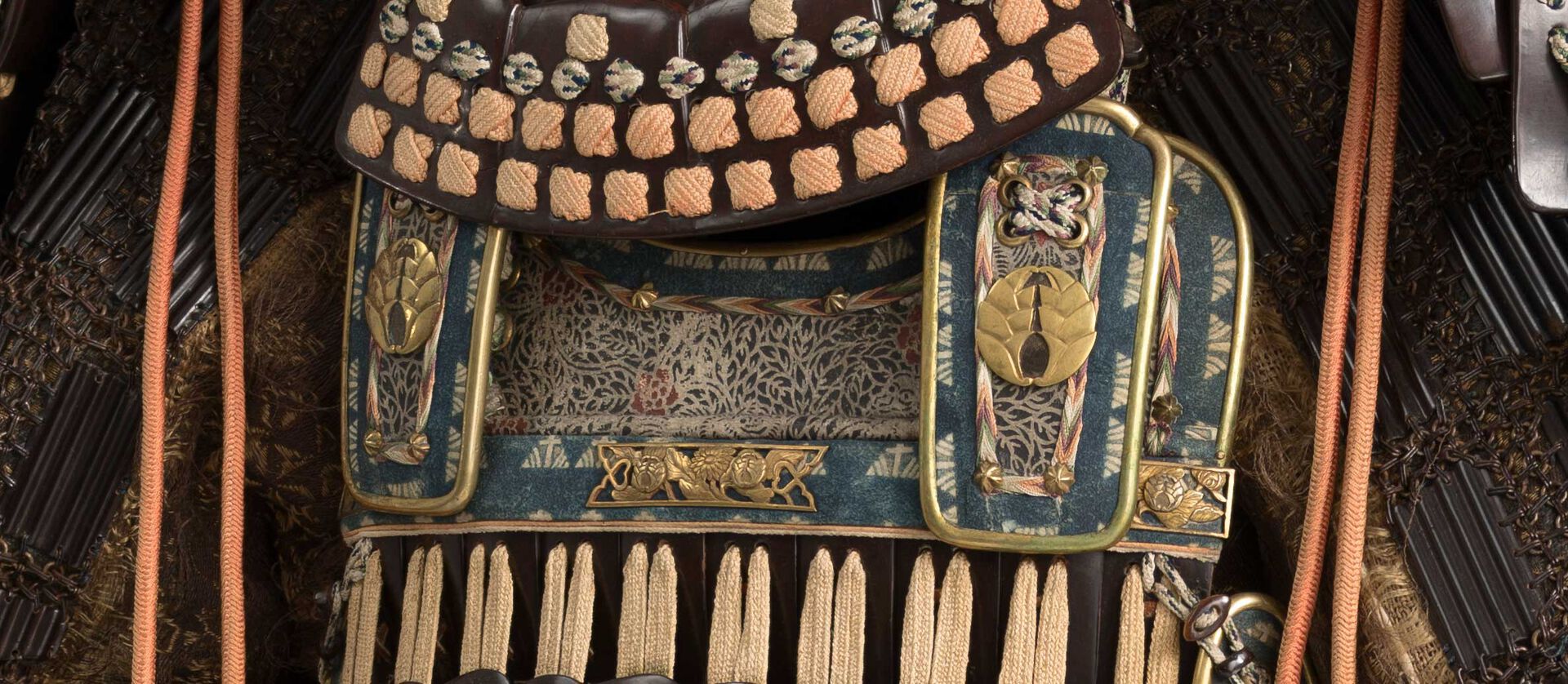
The family symbol, mon, which is found on several parts of this armor shows two apricot leaves, gyoyo, known as a gyoyo mon. The gyoyo mon found on the armor was used by several families, the most prominent being the Nabeshima, different branches of this clan were daimyo various places in Hizen. Note that gyoyo is also the name of the small protective plates for the straps of the breastplate, that often have the shape of two opposing apricot leaves.
This mon is very similar to one which shows two ginger shots, myoga, the difference is that the apricot version shows no leaf veins. When the armor was registered in the museum the mon was incorrectly seen as myoga which was popular with the warrior class as myoga written with other characters (kanji) may be read “divine protector”. It was used by a number of families, the most prominent being the Hori, daimyo of Iida in Shinano, and the armor was therefore in the catalogue attributed to a member of that family.
Unfortunately, we have no information about how Roald Amundsen got his armor, he mentioned nothing about it when he made the presentation to the Ethnographic Museum. He met with several prominent figures in Japan, including members of the Imperial family. When he received the aviation medal two well-known generals, Nagaoka Gaishi and Hongo Tsunamoto as well as Japan’s own polar hero Nobu Shirase were present. Any of these or several others could be the donor.
Helmet, kabuto
The helmet bowl (hachi) consists of 24 identi¬cal triangular plates. At the lower end they are connec¬ted by an iron ring known as koshimaki, at the top they meet around a hole, tehen. The plates are alternatively a gold-colored plate with additional ornaments or three sabi nuri brown plates, giving four golden and four dark fields. (The sabi nuri are layers of urushi lacquer prepared to create a textur ed, antique, rust-like finish.) This pattern is called shihojiro, literally "four whites". On the gilt fields there are arrow-shaped ornaments of gilt brass, shinodare, three such arrow ornaments at the front, two on the other three gilt fields. All these ornaments are held in place with five tiny nails each. The sabi nuri browned plates all have five visible nail heads, arranged in diminishing size towards the tehen which is surrounded by a five layered gilt ornament, tehen kanamono.
Around the bowl, on the koshimaki, are four gilt and pierced ornaments evenly spaced, kanamono, each having two heraldic symbols, two mon.
At the back of the helmet bowl is a small gilt ring, kosho-no-kwan, with a tasseled cord, agemaki, made up in a special bow of dragonfly shape. The ring is for attaching a pendant, the cord to prevent it from rattling against the helmet.
The helmet is fitted with a rounded peak, mabizashi, covered in patterned cloth, framed by blue, stenciled leather, with brass edging. In the middle of the peak is a pierced and engraved gilt mount, kuwagata dai, decorated with three chrysanthemums and with three heraldic symbols. Inserted into the kuwagata dai, and emerging from it, are two ornaments in the shape of stylized scythes, kuwagata, and between them a holder for a helmet crest, maedate. The crest is made of carved and gilt wood in the shape of a hollyhock leaf, aoi.
There is a neck guard, shikoro, of five black lacquered lames, each lame consisting of small, individual iron plates, laced together by a pale yellow/gold colored braid set in pairs, sugake odoshi, the lowest lame having a double row of red braid.
The upper lame extends into two turned back deflectors, fukigaeshi. These are like the peak covered in cloth and blue leather, and both the fukigaeshi and the peak have a flat cord, fusegumi, following the outline and fastened with flower shaped ornamental nails, hassô-byô.
Each of the fukigaeshi has a large gilt heraldic symbol in the shape of two confronting apricot leaves, the gyoyo mon.
The helmet retains its original lining, ukebari, (rifted) and original fastening cord.
Signature, mei: The helmet bowl is signed on the inside: UNHAN HARUTA MURAJI KAZUHISA. (KAZUHISA can also be read as TSUNEHISA.)
This smith was active in the mid-Edo period and lived in Izumo Province where he was an official katchushi – armorer – at the Matsue dōmain. The suffix Muraji is an old title, in this example it is used by the retainer himself to refer to the dōmain he served. He is listed on page 552 in the “Shin Katchushi Meikan” by Sasama Yoshihiko, but not in “Japanese Armor Makers for the Samurai” by Chappelear.

Mask, menpō
The mask is of the ryubu-men type, i.e. a smooth surface without wrinkles. It has a detachable nose piece, a big, bushy mustache and a small goatee beard made of animal hair. The surface is browned sabi nuri, now with some additional, not controlled rust, the inside of the mask is lacquered red.
It has a throat guard of three brown lacquered lames made up of single plates with a slightly curved upper edge. They are laced like the shikoro with yellow braids in pairs, sugake odoshi, and with a multicolored braid on the upper plate running along the edge down to the lower plate. There it is followed, at the bottom, by two rows of pale red braids.
Cuirass, dō
The cuirass is a mogami- dō, opening on the right-hand side, with a long hinge on the left-hand side. On both sides of the opening and of the hinge, a small plate, hinged to the breast plate and the backplate. The top of the breast plate is covered in blue stenciled leather and has a narrow brass frame, the rest of the breast plate is five rows of individual scales (a “scale” is an iron, steel, or leather piece that together with other such pieces form a lager plate, an arrangement called honkozane), lacquered dark brown and laced with yellow braids in pairs, sugake odoshi. The top two rows are shorter to give room for the plates under the armpits, and these are (like many parts of the armor) covered in stenciled leather with brass edges.
The backplate is constructed like the breastplate. The individual plates of the breastplate and the backplate are tightly bound together with leather strips, invisible from the outside. In the middle of the backplate is a gilt ring holding a large agemaki tied cord as well as being a fastening point for cords from the shoulder guards to prevent these from flapping when riding.
Tassets, kusazuri: Eight kusazuri, each of five rows of plates, the lacing is the same style as the other parts of this armor, yellow laces in pairs, sugake odoshi, with one multicolored and two rows of pale red braids (here very pale) on the lowest row.
Gyoyo: Covers to protect the upper fastening straps. [Independently numbered, 6 and 7, see below.]
Shoulder guards, sode
The sode are of medium size, chu-sode. At the top of each guard there is a plate covered in a patterned cloth and with brass edging. On the underside, these plates are covered in blue, stenciled leather. From these top plates hang six rows each made of seven iron scales, with a curved upper edge. Brown lacquered and laced with yellow braids in pairs. The lowest row has a row of multicolored braids, and two rows of pale red.
On the middle row a pierced and gilt ornament, kanamono, decorated with chrysanthemums and two mon, the same as found on other elements of the armor. From these kanamono there is a tasseled cord which is fastened to the agamaki bow on the back plate to avoid the sode from rattling.
Shoulder strap protector, gyoyo
Each shoulder strap protector covers to protect the upper fastening straps. These plates were typically leaf shaped, and gyoyo literally means apricot leaves. On this armor the plates are rectangular, but the gyoyo-shape is still to be found, albeit in the mon, centrally placed on the plates (in our collection the armor with number UMN6233 has leave-shaped gyoyo, but with another mon centrally placed).
Further, the plates are covered in ornamented blue and black leather with brass edgings. They have two holes which enable them to be fastened, preventing them from being caught by the bow string.
Arm guards, kote
The kote is of shino-gote type with iron plates connected with chain mail, all fastened to brown- and gold-colored brocade. On the upper arm four rows of five rectangular, lacquered plates, with a ribbed surface, a total of 20 plates. The elbow is covered with a circular arrangement of plates, with a brass nail in the center. On the lower arm are three slightly curved, rectangular plates. The hands are covered with one plate covering the back of the hand, with embossing over the knuckles, and a smaller one for the thumb, both hinged. All plates of the kote are lacquered dark brown like the other metal parts.
Skirt, haidate
Each of the two main parts of the haidate is made up of rectangular plates in five rows with 22 plates in each row. The plates are fastened from edge to edge with a pale red braid.
Shin guards, suneate
The shin guards are made up of five ribbed iron plates each, shino, three long and two shorts, connected by chain mail and mounted on brocade. The area below the short plates, which is the part on the inside of the leg, are made of tanned leather, neri-gawa. This is where the shin guards meet the stirrups, abumi, it is called abumi-zure. There are two tying bands on each suneate. On the top of the shin guards is a cloth with a hexagonal padded pattern, tateage.
Sandals, zori
With the armor came a pair of standard straw sandals for everyday use.