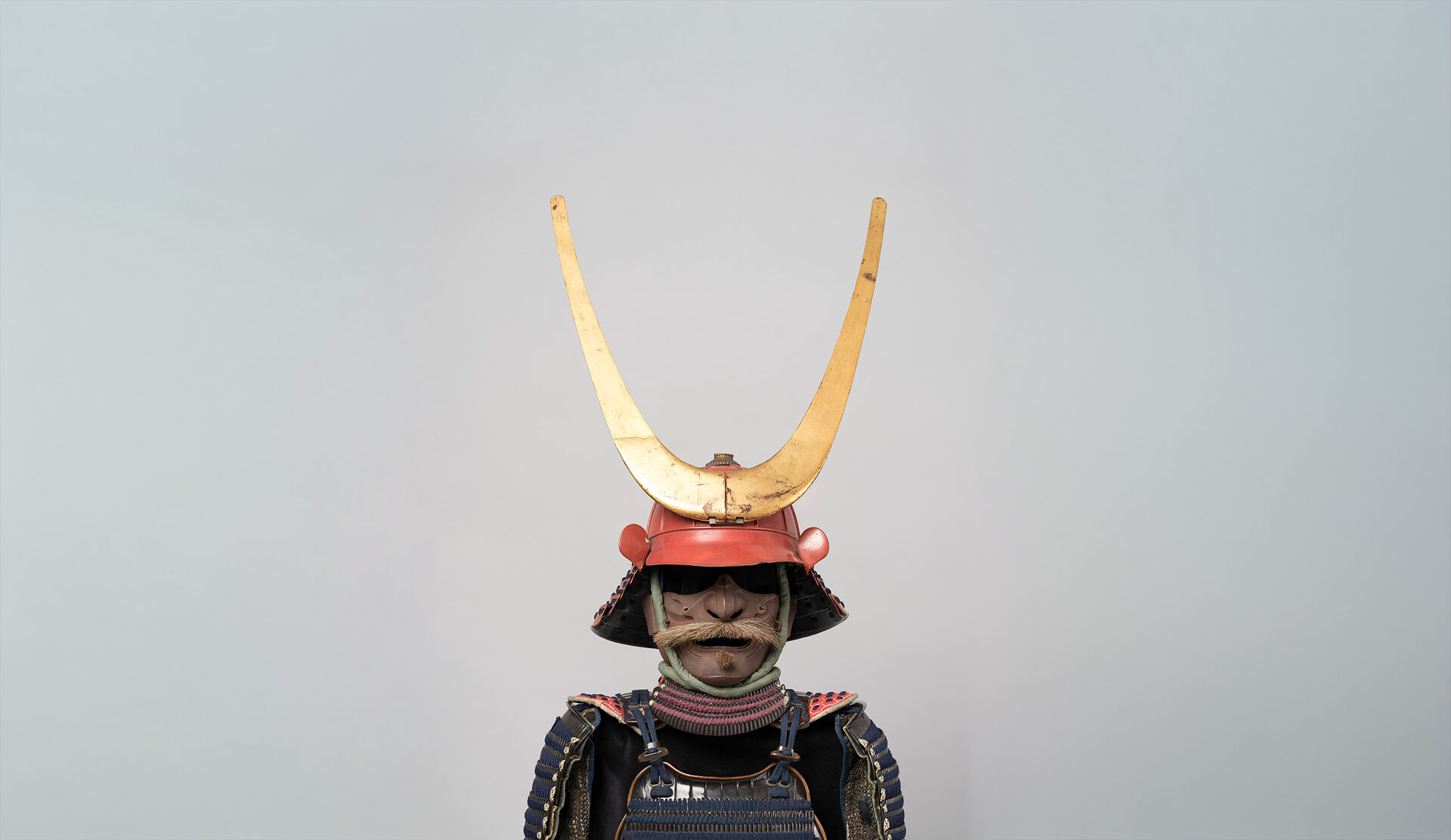
The armor is made up of parts from at least three different suits of armor; the helmet from one, the mask from another and the remaining parts from one or two other armors. The components match well, and the armor may have been used in its present state.
Helmet, kabuto
Made of twelve triangular plates meeting around a small hole, tehen, at the top. The shape of each plate is slightly curved, and the overall shape of the helmet bowl is a little higher at the rear end, a shape called something like “koseizan” (in English texts, uncertain Japanese word), i.e., a “rear power mountain”-helmet. A curved peak with a turned over edge at the front. Around the tehen is a six-layer mount in copper. The helmet bowl and the peak are lacquered red. The neck guard, shikoro, of five red lacquered iron plates, are bound together with dark blue laces in pairs. The upper plate is turned up into two small deflectors, fukigaeshi, one on each side of the face.
At the front a two-pointed bracket for a helmet crest, maedate, which is missing. The two wooden horns with gold paint in the photo do not originally belong to the helmet (and lack a separate museum number in the database). But they fit the two-pronged maedate holder perfectly and were used as in the photo in the SAMURAI exhibition.
The lining is intact; hence it is not possible to see if the bowl is signed. The helmet cord is also present.

Mask, menpō
Of fierce looking type, ressei-men, lacquered in russet lacquer, sabi-nuri (layers of urushi lacquer mixed with iron filings or iron oxide powder), having a detachable nosepiece with a mustache of horse or wild boar hair, on the chin a small goatee beard. The inside is lacquered red.
The mask has a neck guard of four black lacquered plates bound with purple laces.
Cuirass, dō
Made in two parts hinged on the left-hand side. The breast and back plates have tight dark blue lacing. On the breastplate there is one embroidered badge and one gilt ring on a flower shaped mount. This ring is for holding a commander’s baton and a handkerchief.
Tassets, kusazuri: Seven kusazuri each made of five black lacquered plates with tight dark blue lacing.
Shoulder guards, sode
Medium sized black plates with dark blue laces, at the lower end one multicolored and one red lace.
Arm guards, kote
Lacquered metal plates with chain mail on silk brocade. Blue cotton lining.
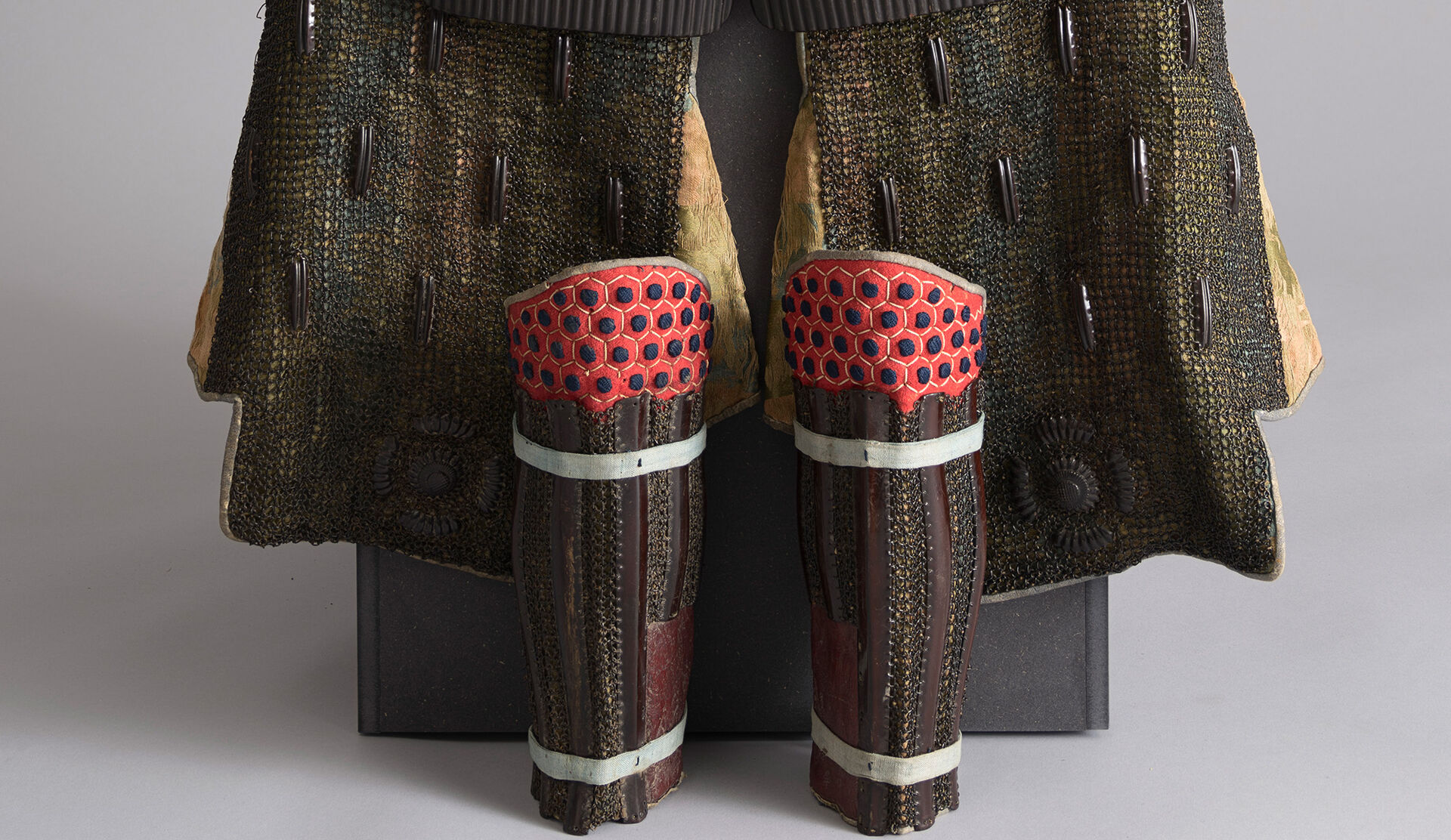
Skirt, haidate
Made of chain mail, kusari, enforced with metal plates, mounted on silk brocade. Cotton lining.
Shin guards, suneate
Each consisting of seven vertical, lacquered metal plates on chain mail, kusari.