The Norwegian Halvor Halvorsen went to sea at the age of 14 but escaped from a cruel captain and the ship he was assigned to. He took his new name, Oliver Smith, from a good captain, and after many years at sea got a job as a pilot in the Japanese city of Kobe in Hyōgo, where he also got married and had children. In the 1880s he donated 450 objects to the Ethnographic Museum in Kristiania (now the Museum of Cultural History in Oslo), including two suits of armor, which came to the museum in 1884.
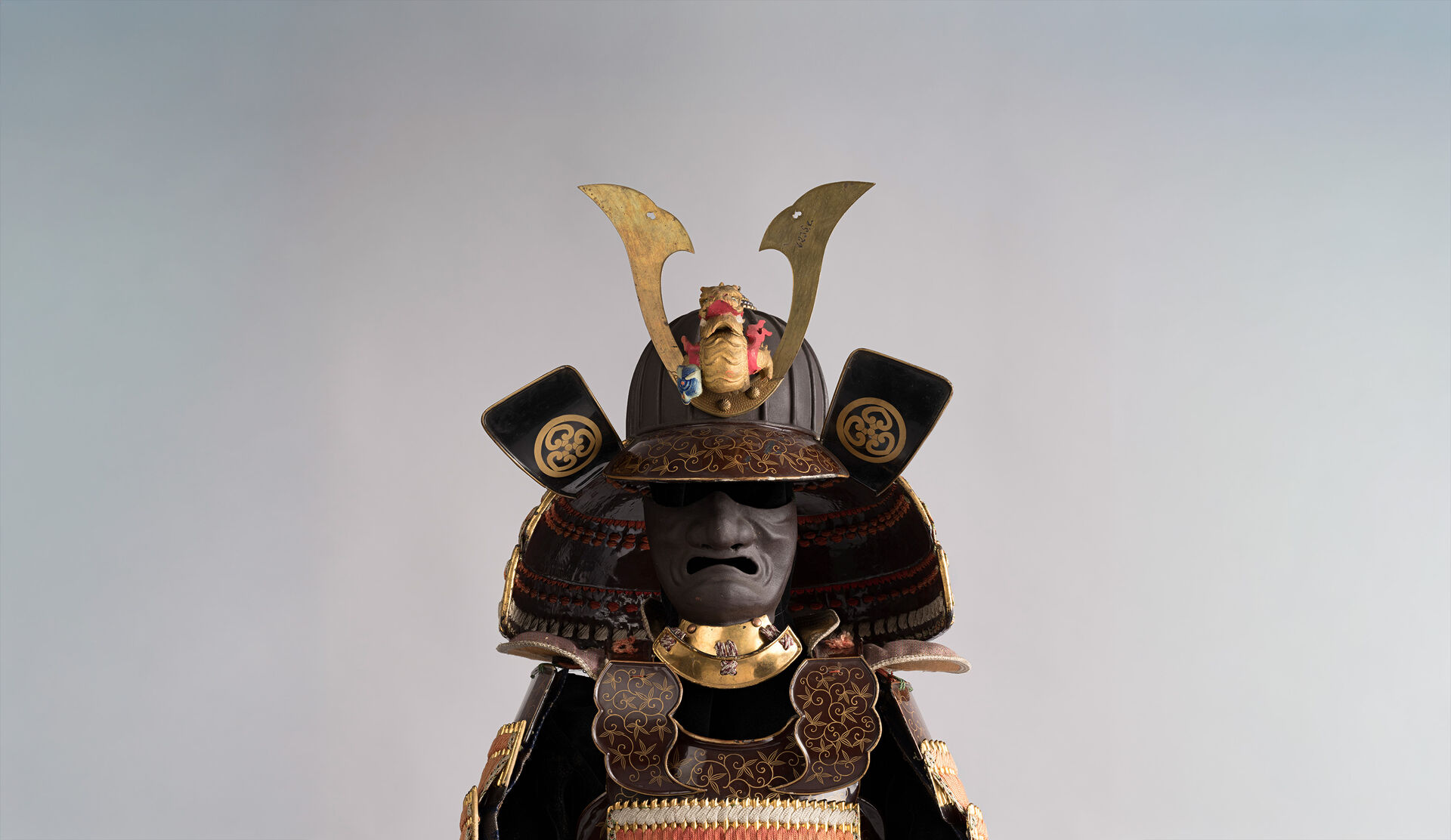
On the deflector of the helmet there are what appears to be family symbols, mon. The middle part of this mon consists of three double edged swords, known as ken. These look like arrows. They are surrounded by three floral elements. It has not been possible to identify the mon.
Helmet, kabuto
The helmet bowl is made of pressed papier mâché. The outside is built up with ribs, so it appears to have been made of 20 plates, as if it was a 20 plate sujibachi. Lacquered dark brown, sabi nuri.
On the top is a six layered ornament, tehen kanamono. The peak, mabizashi, is lacquered brown with tendrils in gold. The neck guard, shikoro, consists of three gold lacquered plates with red lacing, on the lower one a row of white braids.
A deflector, fukigaeshi, is fastened on either side on the upper plate, lacquered brown and with a mon in gold lacquer (see comment above).
Helmet crest, maedate: A dragon with a jewel, tama, made of wood and painted in gold and colors. There is also a brass ornament, kuwagata dai, adorned with three chrysanthemums, holding two scythe-like brass plates, kuwagata.
Mask, menpō
Made of pressed papier mâché with ressei men, or angry looks, lacquered brown sabi nuri, black inside. The throat guard is made of two gilt plates with brown and white braids.
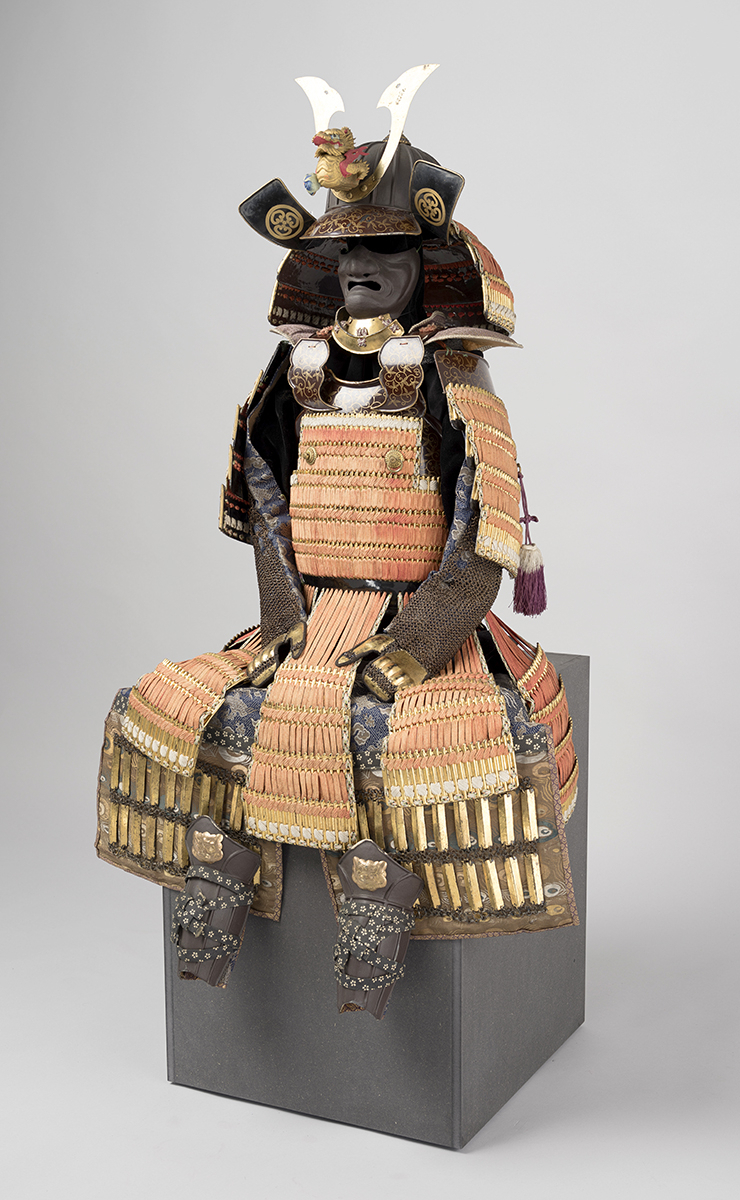
Cuirass, dō
In two parts, ni-mai dō, made of pressed papier mâché and hinged on the left-hand side. The upper part of the breast plate is lacquered brown with gold tendrils. The rest is lacquered gold with tight lacing in red.
There are two brass mounts with rings (one ring is missing) on the breast plate, one for a commander’s baton, saihai, and one for a handkerchief. The breast also has two leaf shaped parts, gyoyo, to cover the knots of the shoulder straps, lacquered brown and tendrils in gold.
On the back plate a tasseled cord in purple and white fastened in a brass ring and mount. Neck- and shoulder padding in brown and gold brocade.
Tassets, kusazuri: Four plates in each, gold lacquered and laced in red, the lower one with wide white and narrow multicolored braid.
Shoulder guards, sode
Relatively large, the top plate is lacquered brown with gold tendrils, then four lames lacquered gold with red laces. Pressed papier mâché. A brass mount with a ring has purple and white silk chord with tassels. This was for tying together the shoulder guards so they would not flap during speed.
Arm guards, kote
Chain mail on blue brocade, the hands are covered by four gilt papier mâché plates, linked so the wearer could bend his fingers. Cotton textile lining.
Skirt, haidate
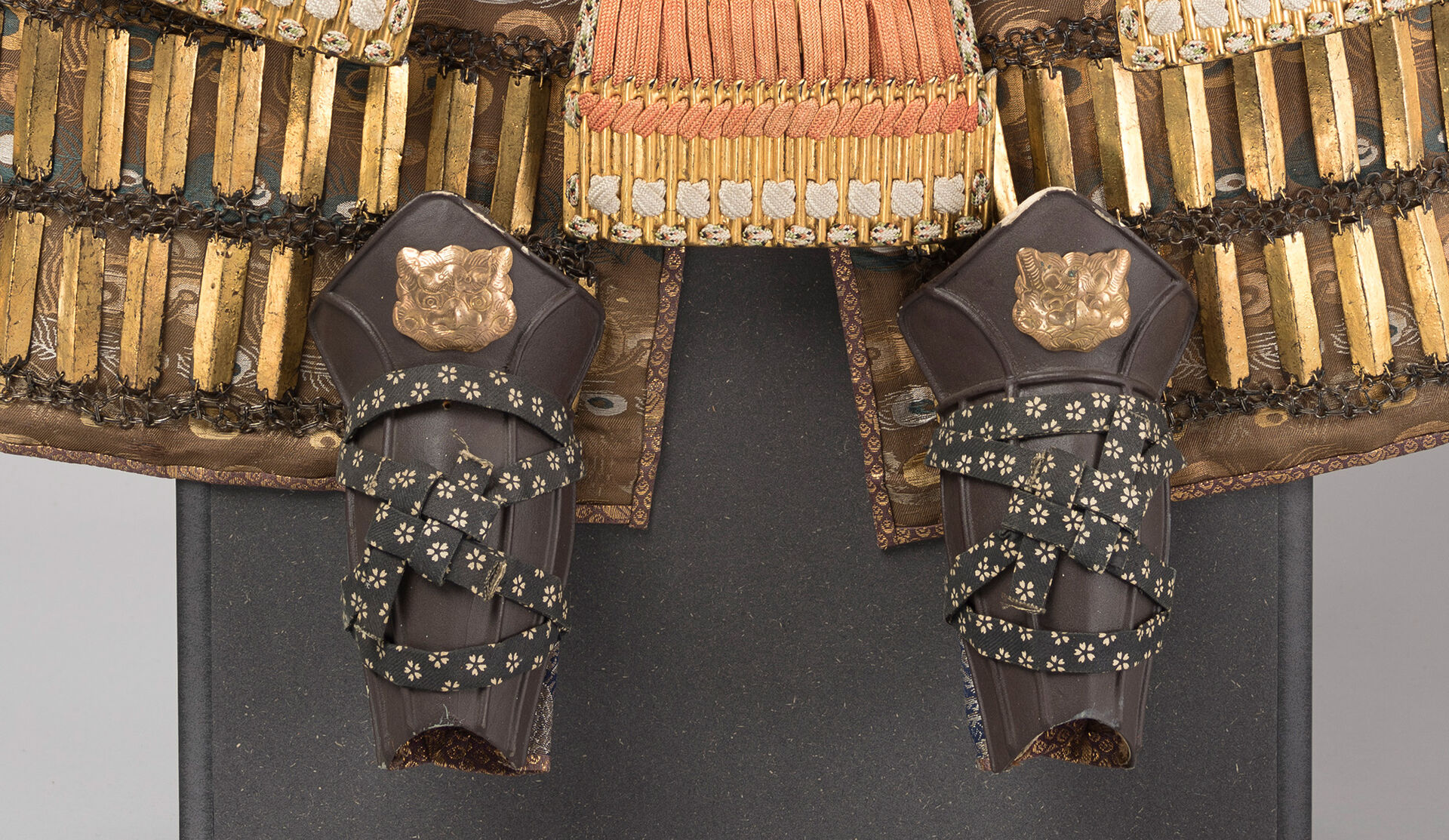
Two rows of 10 gilt plates mounted on brocade, brown cotton textile lining.
Shin guards, suneate
Thin profiled plates made of pressed papier mâché, lacquered sabi nuri, mounted on blue brocade, and with what appears to be a somewhat nice-looking oni in brass at the top. (An oni (鬼) in Japanese folklore is a “demon”, but with trollish elements as it is part of nature. See the helmet of UEM18237 in our collection for a slightly more fearsome looking oni.) Decorated in front with patterned cotton band.
Dagger, tanto
With the armor is a dagger, tanto. This one is without guard between the hand and the blade and is called an aikuchi. The blade is flat, hiratsukuri, total length 25.7 cm, length of cutting edge 18.3 cm, width at end of cutting edge 1.7 cm. Some patches of rust. The tang is unsigned, mumei, with one hole (the tang is the part of the knife blade that goes into the handle).
The habaki is made of silver (the habaki is the metal piece that wraps around the base of the blade next to the handle). The grip is wrapped in thin, black tread with some defects and the top mount, kashira, is missing.
Scabbard for dagger
The scabbard belongs to the dagger above. Made of silver with engraved decoration of reeds.