
The collection came to the museum from the company of Carl Hagenbeck in Hamburg in 1887. In the mid-19th century, Hagenbeck was well-known in Europe as an animal trader. He also played a significant role in spreading African and Asian ethnographic materials around Europe through commercial sales. The presence of many of the earliest Sinhalese ritual dance masks in European collections originated from the business ventures of Carl Hagenbeck.
Hagenbeck in Ceylon
Carl Hagenbeck came from a family with a long history of trading wild animals from Africa and Asia to Europe and the United States of America. He was the elder son of Gottfried Claus Carl Hagenbeck Sr. (1810-1887), an animal trader and fishmonger. Carl Hagenbeck’s connection with Ceylon began in 1884 with his exploration of local cultures and communities, and wild animals for his international animal trading project. Carl’s brother John Hagenbeck (1866-1940) was assigned to Ceylon to support their professional business of animal trading and plantation. As a part of his effort to bring exotica to the west, a large number of elephants and other animals from Ceylon were exported to different parts of Europe.

The Department of National Zoological Gardens in Dehiwala, in Ceylon’s capital Colombo, was originally established by Hagenbeck in 1905 as a place to rest animals before transporting them to Europe. Carl Hagenbeck’s involvement with training wild animals and collecting them from Africa and Asia from 1878 onwards extended into curatorial projects exhibiting native cultures in 'Ethnic Shows,' the 'Human Zoo,' and the 'Carl Hagenbeck Circus'. In these projects, he exhibited both animals and indigenous people and their ethnographic objects and materials. The Ceylonese and Indian pavilions included Buddhist monks, ritualists, dancers, drummers, craftsmen and craftswomen, children, and different types of ethnographic materials and objects, including Sinhalese ritual dance masks. Two of the earliest curated exhibitions of Sinhalese masks were in Berlin in 1884 and in the Chicago World Fair in the United States of America in 1894. Hagenbeck confirmed that the great Cinghalese (Sri Lankan) exhibition was one of his largest ethnographic shows. The Cinghalese received a great reception in his shows; they were presented under the theme of 'magic and mysticism,' a culture alien to European communities. The present collection of Sinhalese masks at the museum was a historical consequence of Hagenbeck’s activities.

The Museum Collection and Ritual Contexts
The forty-one objects from Carl Hagenbeck’s ethnographic collection include several rare masks from the Rāksha and Yaǩkā cults. These masks depict human, animal, bird, and mythical characters, and two objects associated with ritual dance traditions. The masks would have been mainly used in Sinhālese ritual ceremonies. This rich tradition of Sinhālese rituals originates from a complex system of belief in gods and goddesses, and demons and how to propitiate them. For instance, the rituals held for obtaining blessings from gods and goddess are known as Gammaduwa or Devolmaduwa.

Other forms of ritual are held to remove demonic influences on humans. These are known as Bali, Sūniyama, Sanniyäkuma, Mahāsōn Samāyamā, Garayakuma and Rāta-yakuma. Another form of ritual ceremony is known as Kôlam. Kôlam is a theatre-like performance in which popular stories are enacted for entertainment. All these rituals originated in the southern part of Sri Lanka and are associated with Southern or Low-country dance traditions (pahatha-rata nařthana sampřadāya). Knowledge and traditional practice of these rituals have been passed down through families (parāmparā) for hundreds of years. Lineages of ritual specialists have been established in Mātara, Galle, Bentōta, Ambalaňgoda areas in the southern part of the Sri Lanka. Later, these ritual practices have extended to Olabodūwa in Raigama Korale and Gampaha areas in the Western province of Sri Lanka.


Ritual ceremonies in these traditions fall into two main categories: Shānthî-Karmā or Tovil for healing and Kolam for enactment of folk dramas. The aim of Shānthî Karmā ceremonies, is to propitiate various supernatural beings that are believed to bring misfortune and illness to humans and their environment. These supernatural beings are known as demons (yaǩkā) and devils (rāksha). They are represented by way of images and masks which capture their various characteristics. Bali is the ancient and most complex ritual practice of Sinhalese people. Bali has thirty-five forms of rituals (paňthis-bali). Bali is held to propitiate planetary gods and various demons (yaǩkā). These beings are not represented in the form of masked dancers but as images (bali-rūpā) sculpted in wet clay and painted in different natural pigments. These are ephemeral images. They are left after the completion of the ceremony to decay naturally. The other forms of representing these mythical beings are as images painted on natural leaves and pieces of linen fabrics. Importantly, Bali-Rūpās provide central iconography for various Yaǩkā and Rākshas embodied in masked form in Tovil and also in folk dramas. Most masks in the present collection would have been used for Kōlam theatre and Sanniyakkam Shānthî-Karmā.
Sanniyäkuma
Sanniyäkuma, also known as Dāha-atā Sanniya, which means ritual of the eighteen (dāha-atā) diseases (sanni). The birth story of Kôlā Sanniya [the king of the eighteen demons] and his eighteen sanni yaǩkū is known as Saňkapāla Kathāwa. The Sanniyäkuma, is one of the major Sinhālese healing rituals and is held to cure a sick person (āthurayā) from different types of physical or psychic diseases. In a Sanniyäkuma, eighteen diseases are addressed through masked play. This healing ritual takes place in a prepared open-air space at a house of the patient. It continues until the morning of the following day. In the past, it was believed that the Sanniyäkuma ritual was held under the superiority of the sanni demons (sanni yaǩku) who were believed to have made the patient sick.
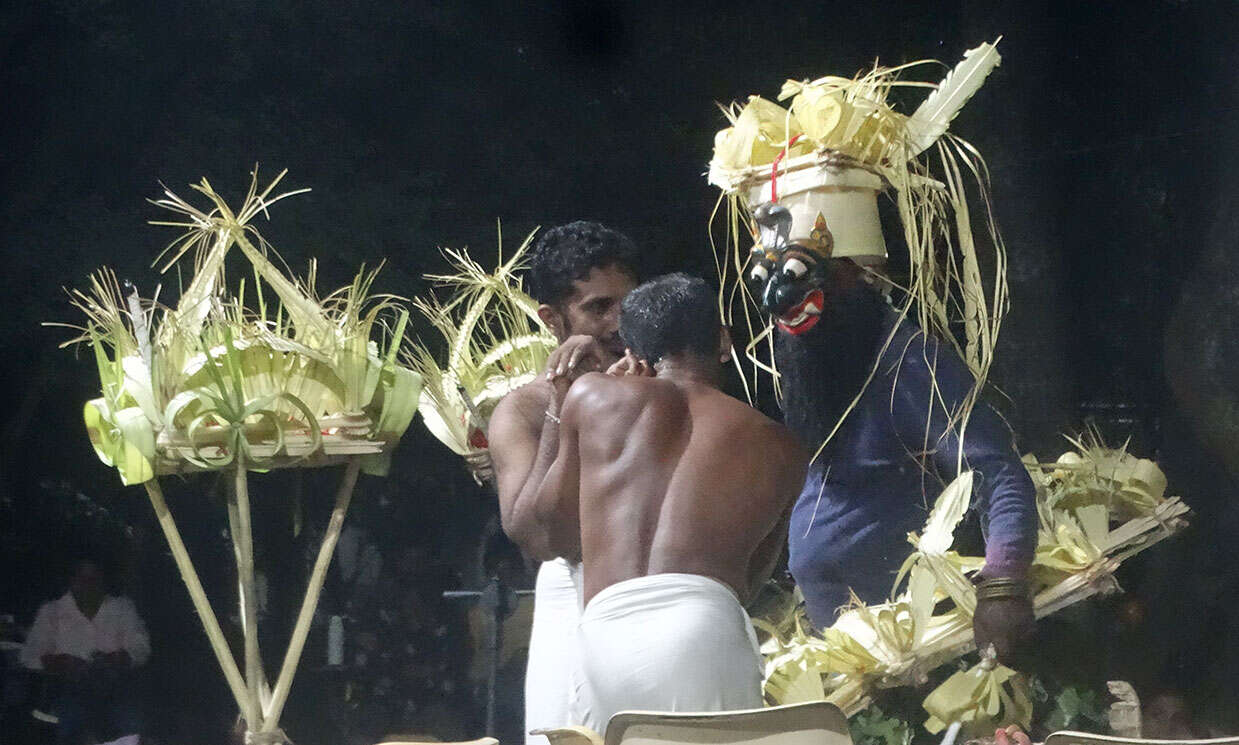
The aim of the ritual was to heal the sick person by propriating such demons. In addition to the eighteen demons, there are five major demons propitiated in the Sanniyäkuma ritual. They are known as the black demon (Kalu-Yaǩkā), the blood demon (Rîri Yaǩkā), the demon of Abimana (Abimāna Yaǩkā), the demon of sorcery (Suniyam Yaǩkāňî), and the great demon of the graveyard (Mahāsōnā). Representations of these Yaǩku in masks do not happen in all regional traditions in the same way. The masked play in this ritual is full of poetical verses (sanni kavi) sung by the main ritualist and masked dancers, and conversation, humor, and interaction between drummers, patient and audience. Ritual performers create a vibrant atmosphere through dancing with masks and fire torches, playing instruments, singing poetical verses, and reciting mantra. All these activities are combined to heal the patient and bring him or her normal life. A Sanniyäkuma ritual ends with the masked dance of Kôlā Sanniya, the king of all eighteen sanni demons. It is interesting to note that there are only two masked dances in which the dancers reveal their actual face by removing the mask in front of the patient. Kôlā Sanniya is one of these and the other is a demon known as Garā Yakā who appears in Kōlam theatre and the Garā Yakumā ceremony.
Kōlam Theatre
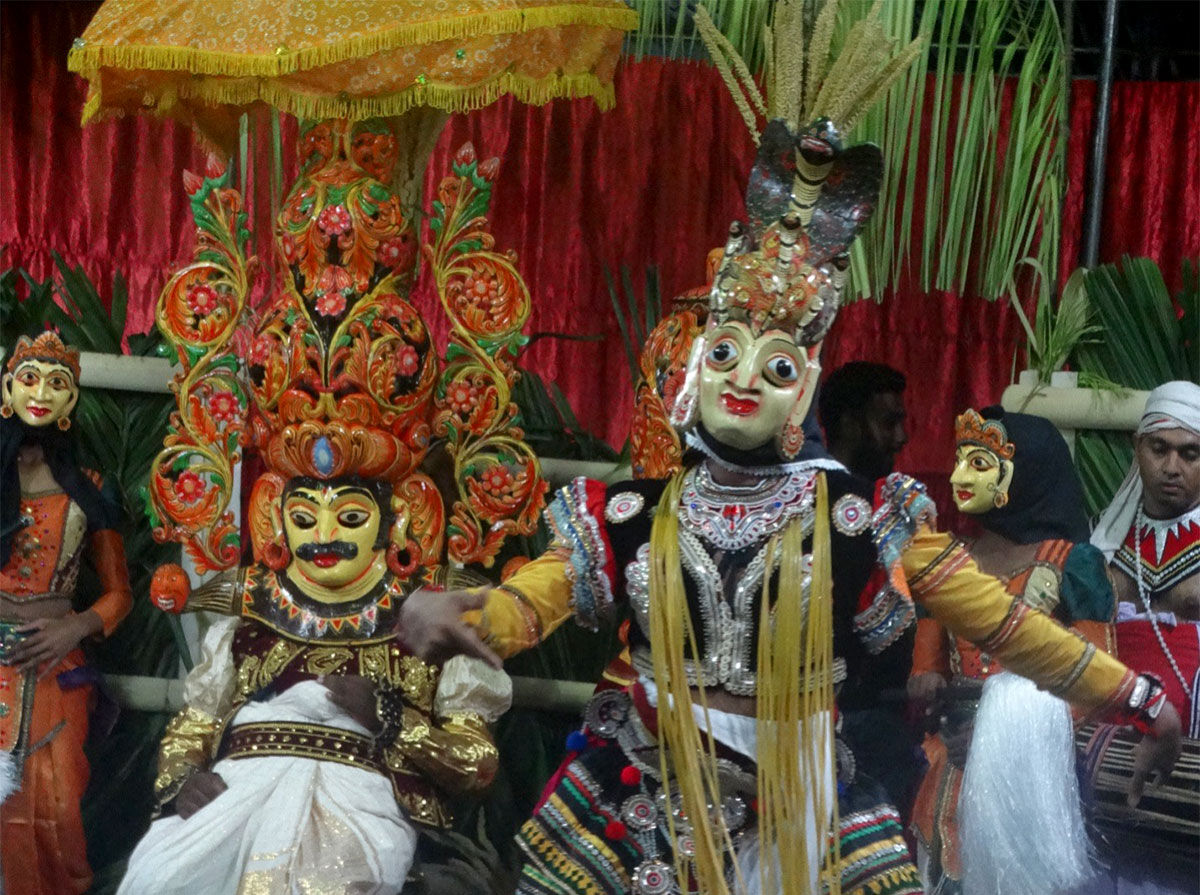
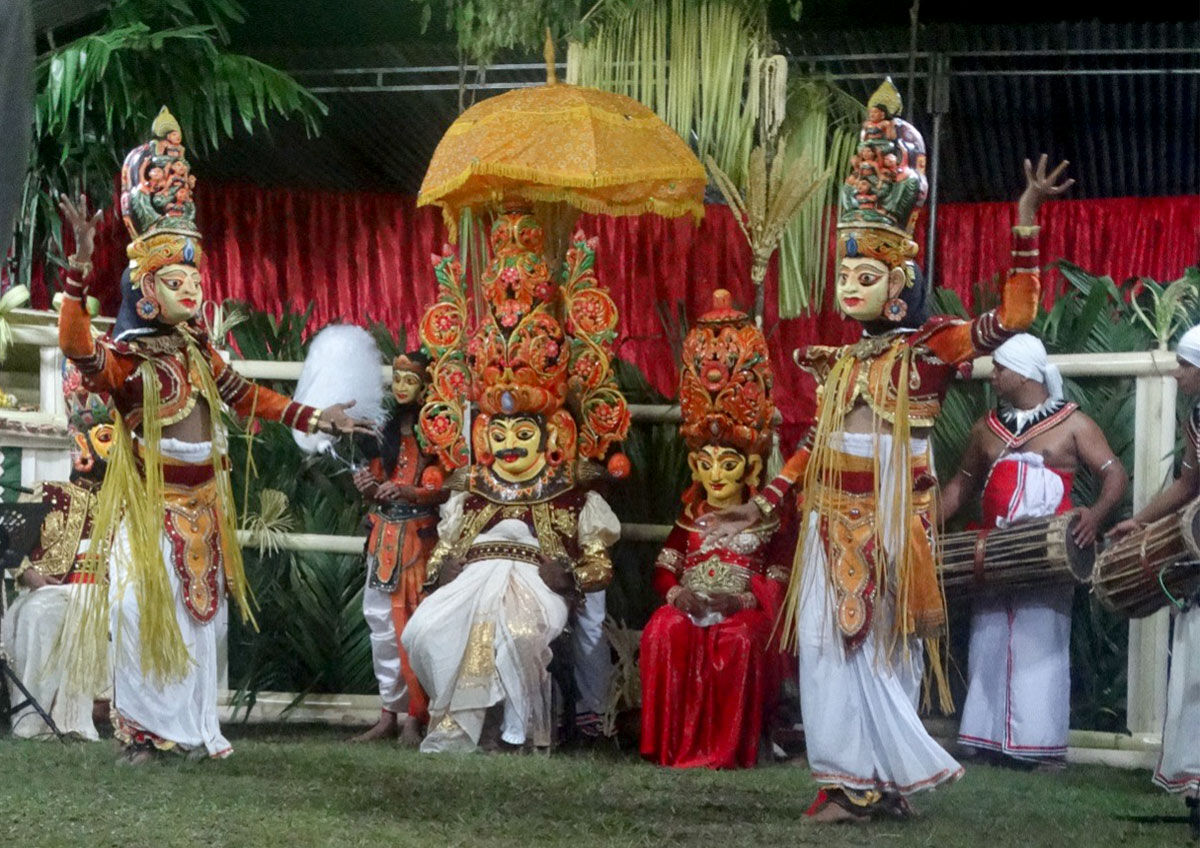
Kōlam theatre uses the largest number of masks of any Sinhalese ritual. This ceremony is also known as Kōlam Nateēmā. The birth story of Kōlam dance refers to a legendary character, King Mahā-Sammathā. Based on this legend, the drama came about because of the desire of the pregnant queen of Mahā-Sammathā to see a masked dance. In this ritual drama, the King and Queen also appear in two larger size masks and watch different characters and stories represented in masked dances. It starts in the evening and continues until the morning of the following day. The main function of this ritual ceremony with masked performances is to narrate multiple stories from the Buddha’s previous lives (jātaka-katā), stories of mythical characters related to different legends, and different stories depicting rural life and different ethnic groups. The breadth of stories narrated in this ritual drama has resulted in a wide range of masked characters. For example, mythical beings known as Rāksha appear in the form of birds, animals, humans, and foreign characters. Kōlam dance ends with the mask performance of Garā Yakkā. The presence of Garā Yakā is believed to bring success, purification, and prosperity to the humans present. As mentioned, the Garā Yakā dance is the other performance that ends revealing the actual face of the dancer in front of the audience by removing the Garā Yakā mask.
Acknowledgements to Dumith Kulasekara, artist and PhD student in Conservation and Restoration of Cultural Heritage School of Art/University of Catholica Portuguese, Portugal, who contributed to write and translate this web presentation.
Sources
Bentharage, L. (2025, August 14). Sinhalese Masks. (D. Kulasekara, Interviewer)
Biography of Carl Hagenbeck. 2021. Elephant Encyclopedia.
Dagnoslaw Demski and Dominka Czarnecka. 2021. Staged Otherness: Ethnic Shows in Central and Easten Europe 1850 – 1939. Vienna: Central European University Press.
Department of National Zoological Gardens. (n.d.). Ministry of Environment Sri Lanka.
Discover Our Archives: Hagenbeck, Carl, 1844 - 1913. (n.d.). University of Sheffield.
Dreesbach, A. (2019, January 24). Colonial Exhibitions, ‘Völkerschauen’ and the Display of the ‘Other’. Retrieved February 3, 2026, from Brewminate: A Bold Blend of News and Ideas.
Goonathilaka, M. 1978. Masks and Mask Systems of Sri Lanka. Colombo: Tamarind Books.
Hugh S. R, and A.G Thacher. 1912. Beast and Men: Being Carl Hagenbeck's experiences for half a century among wild animals. New York: Longman Green and Company.
Kapferer, B. 1983. A Celebration of Demons: Exorcism and the Aesthetic of Healing in Sri Lanka. Indiana University Press.
Obesekara, G. (April 1969). The Ritual Drama of the Sanni Demons: Collective Representations of Disease in Ceylon. Comparative Studies in Society and History, 174-216.
Rainer, C. V. (n.d.). “1884/1885 Singhalesen der Hagenbeck’schen Ceylon-Expedition”. Human Zoos.
Simpson, R. (1984). Rural Tradition and Performance: The Bereva Cast of Southern Sri Lanka. PhD-thesis, University of Durham.