Published
June 20, 2025 6:53 PM
Later this year, the Viking ships will be moved for the first time in nearly 100 years in what is likely Norway's most spectacular moving project.
Later this year, the Viking ships will be moved for the first time in nearly 100 years in what is likely Norway's most spectacular moving project.
Secrets of the Ice receives the European Heritage Award / Europa Nostra Award 2025 for its groundbreaking research and outreach program.
The UNI Foundation has awarded the 2025 Preservation Prize to the University of Oslo for the construction of the Museum of the Viking Age. Along with the prize comes a donation of 70 million Norwegian kroner.
After more than 100 years in storage, the original serpent's head from the Oseberg Ship will be displayed to the public for the very first time.
Sigrun G. Aasland (Labor Party) gained insight into the complicated construction project, where much is proceeding as planned. However, there are still challenges that need to be resolved before the museum can open its doors.
The earliest Scandinavian kingdoms emerged in the late 5th century, inspired by the Roman polity type. The reasons why this happened, and why these developments played a significant role in the rise of the Viking Age three centuries later, are explored by Professor Dagfinn Skre in his new book: The Northern Routes to Kingship: A History of Scandinavia AD 180–550.
The discovery of a remarkably large house from the 3rd century has captured the attention of archaeologists: Could a kingdom have existed in Norway during the Roman period?
This week, another milestone was reached for the Museum of the Viking Age with the roof installation completed on the new museum building.
Today marks the launch of The Great Viking Survey, a global study to explore how people across the world perceive the vikings as history and heritage, and to map the many ways in which contemporary media and academia shape these views.
The Vikings surrounded themselves with textiles that were richly illustrated with stories. 1200-year-old tapestry fragments from the Oseberg Ship are now being pieced together.
They visit Oslo from Canada to study their ancestors' craftsmanship. It was a powerful encounter.
Tuesday was a historic day for the Museum of the Viking Age when the foundation stone was laid at Bygdøy, Oslo.
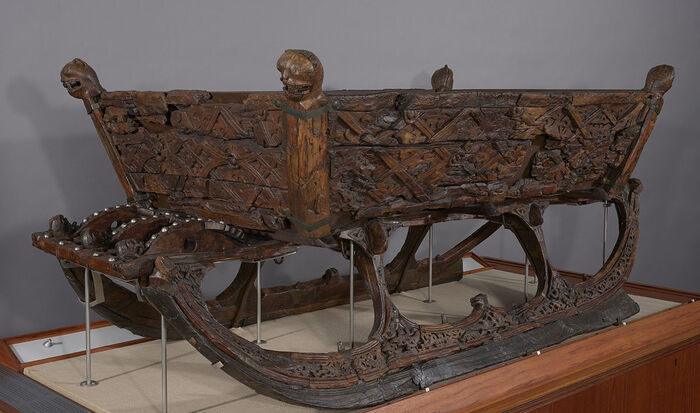
In order to save the unique wooden sleds from Oseberg, they must be conserved using a method that does not exist yet.
The 1st of January 2024 marks the starting date of the ambitious and prestigious project “Archaeological Coastal Heritage: Past, present and future of a hidden prehistoric legacy (ArCHe)”.
The work on the new Museum of the Viking Age is progressing. Today, Minister Sandra Borch got up close and personal to both the construction site and the unique Viking ships at Bygdøy in Oslo.
A total of 35 gold pieces have now been found by the roadside near the Hov farm in Vingrom. "It doesn't get much more spectacular than this," says archaeologist.
The project will research the warrior society of the Viking Age from new angles, and fits particularly well into the museum's research work in relation to the upcoming Museum of the Viking Age.
In close collaboration with metal detectorists, archaeologists have traced an unknown center of power from Norway's prehistory. Now it's secrets will be unearthed in a new excavation.
For the first time the Museum of Cultural History has been awarded a grant under Horizon Europe’s Marie Skłodowska-Curie Actions – Doctoral Networks (MSCA-DN). The network will explore Europe's Stone Age coastal heritage and develop best practices for its preservation.
A new museum building is essential to save the Viking ships. Before we begun construction, the ships needed to be secure – in what turned out to be a unique and spectacular project.
New knowledge about the world's oldest rune stone will be published in academic articles and reports later this year.
An ancient Norwegian rune stone is attracting international attention among runic scholars and archaeologists. The inscriptions are up to 2,000 years old and date back to the earliest days of the enigmatic history of runic writing.
Today, October 1st 2021, a new chapter begins for Norway's most iconic cultural heritage: After 95 years of operation, the Viking Ship Museum has closed its doors - and reappears in a completely new guise in five years.
Our paintings conservators, Kaja Kollandsrud and Linn Solheim will dust and make the Medieval Hall ready for opening, after 6 months with a corona-closed museum.
The new museum at Bygdøy is to be called Museum of the Viking Age. The three Viking ships in the logo honour the main attractions in the outstanding cultural history collection.