
Received funding for further research
In the revised national budget for 2024, the Norwegian government has allocated nine million Norwegian kroner to the Saving Oseberg project. This allows the research project Saving Oseberg to continue its important work and find solutions for how we can best preserve these beautiful and unique objects.
About the project
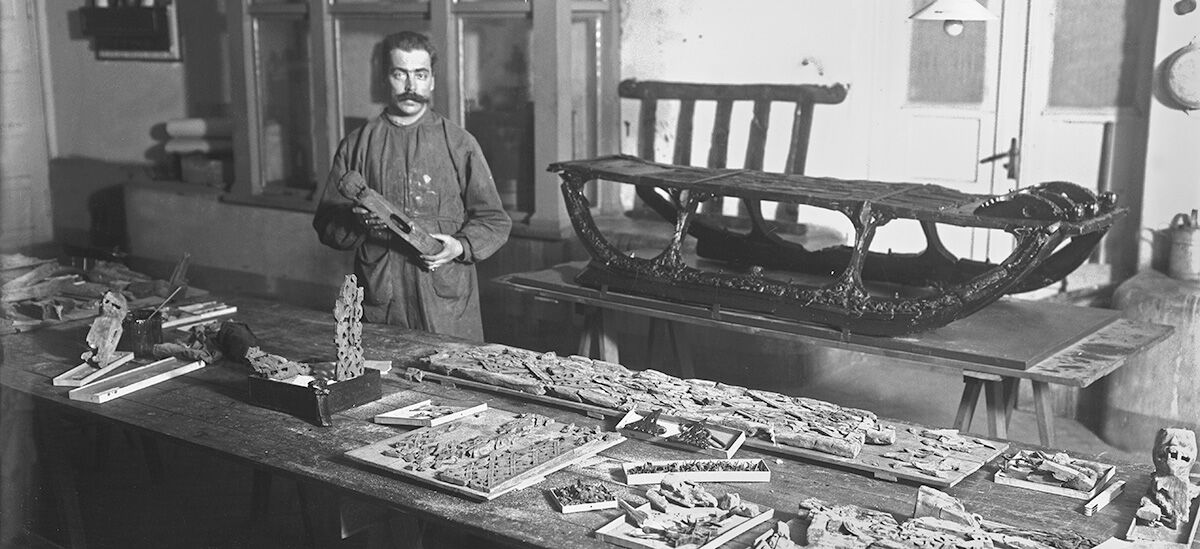
The Oseberg find is one of the most important archaeological finds in Norway and represents the most comprehensive collection of Viking Age wooden objects in the world. Today the artefacts are in alarming conditions due to the conservation methods used a century ago; after excavation in 1904, the most deteriorated wooden objects were treated with alum salts.
The Saving Oseberg project was launched in 2014 to build on findings made during the Museum of Cultural History’s Alum Research Project (ARP, 2007–13); the overall goal of ARP was to provide a scientific basis for the choice of future preservation strategies for the Oseberg find. Saving Oseberg evaluates appropriate options for re-treatment and stabilization of the objects from the collection, based on methods developed in the ARP project and other research groups. It is an interdisciplinary project that combines natural and cultural sciences to preserve archaeological wooden artefacts. Phase 1 of the project had a three year duration (2014-2016), and research in Phase 2 - from lab to pilot focussed on applying methods from the first phase to original Oseberg artefacts. In Phase 3 we aim improve the deacidification method developed and undertake further testing of new consolidants. We will also test aqueous methods on more complex objects, as it has shown to be the most effective in reducing acidity.
Objective
The aim of the Saving Oseberg project is to prevent and/or stop deterioration of the alum-treated wood objects from the Oseberg find. It is important to stabilize and strengthen the artefacts so that they can successfully be preserved for the future. The project centres on five main focuses:
- Documentation: document the alum-treated objects for the future.
- Analysis: analyse the degradation processes in alum-treated wood, including mechanical and chemical characterization.
- Neutralization methods: evaluate and develop methods to neutralize wood and stop active deterioration.
- Conservation methods: test existing polymers and develop new methods and protocols to conserve the Oseberg wood.
- Preventive conservation: implement measures to improve long-term conditions of the finds exhibited at the Viking Ship Museum.
This will allow the Museum of Cultural History to achieve the final goal of preserving the alum-treated objects from the Oseberg find.
Steering Group, Phases 1–2:
(for phase 3, it is still being planned)
- Jan Bill, professor of Viking Age Archaeology and curator of the Viking Ship Collection at Museum of Cultural History, University of Oslo
- Charlotte Björdal, professor, Department of Marine Sciences, Faculty of Science, University of Gothenburg
- Helmer Fjellvåg, Professor of Inorganic materials chemistry, Department of Chemistry, Faculty of Mathematics and Natural Sciences, University of Oslo
- Ingrid Louise Flatval, Head of the Department of Collection Management, Museum of Cultural History, University of Oslo
- Martin Hager Saltnes, Lecturer at the Department of Exhibitions, Education and Public Services, Museum of Cultural History, University of Oslo
Reference Group Phases 1–2:
(for Phase-3, it is still being planned)
- Gunnar Almkvist, Institute for mMolecular Sciences, Swedish University of Agricultural Sciences, Uppsala, Sweden
- Kristiane Strætkvern, conservator, National Museum of Denmark in Copenhagen, Denmark
- Tom Sandström, The Swedish National Heritage Board, Sweden
- Roger Rowell, University of Wisconsin–Madison, USA
- Steve Weiner, The Kimmel Center for Archaeological Sciences, The Weizmann Institute, Rehovot, Israel
Financing
The project is funded by the Norwegian Government and the University of Oslo.