
From royal use to national treasure
Benjarong was made for the Siamese royal family, but as Siam's economy grew, it was also commissioned by wealthy merchants, high-ranking bureaucrats, and members of the country's upper class.
A separate category of benjarong is called Lai Nam Thong, which means "gold-washed". This porcelain has a shiny white glaze, a repetitive decoration, usually without figures, and is decorated with gold in addition to the enamel colors.
The porcelain was intended for use and includes tableware such as bowls with and without lids for eating from, jars with lids for keeping food warm, and saucers for fruit and desserts. There were also spittoons for chewing betel, and small, beautifully decorated jars for makeup and medicine, which adorned the tables of the women of the royal family.
In the late 19th century, porcelain clay was found in Thailand, and the country developed its own porcelain tradition. Nowadays benjarong is made and developed in established craft centers in Thailand. The porcelain is one of the country's national treasures, and a popular wedding gift.

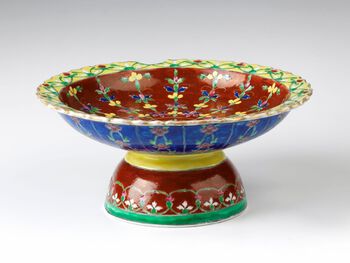
(UEM12950) The word Benjarong originally means five colors, but the porcelain can have more colors than this. Saucer seen from above.
Photo: Kirsten J. Helgeland./Museum of Cultural History, University of Oslo
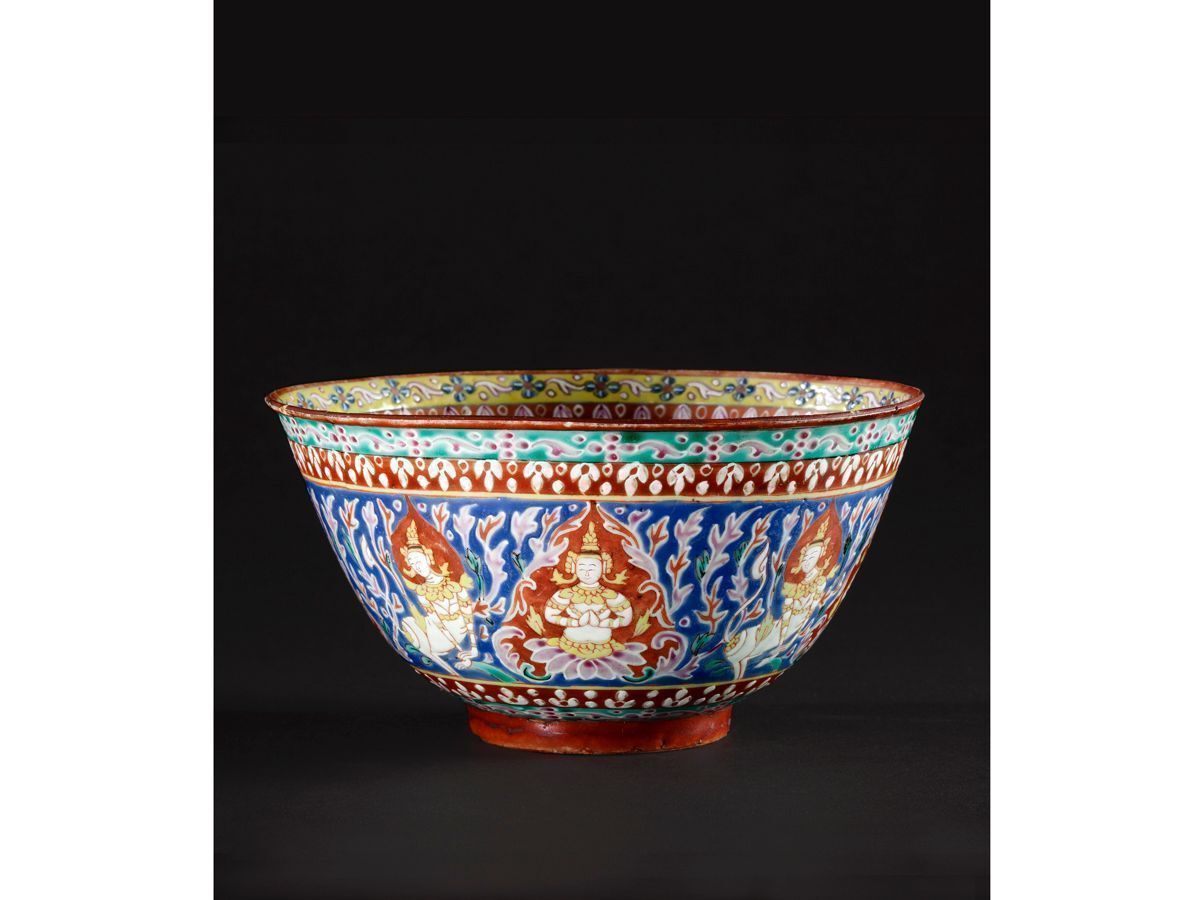
(UEM13042) The deity thep phanom expresses Buddhist virtues such as faith, peace and worship.
Photo: Kirsten J. Helgeland./Museum of Cultural History, University of Oslo
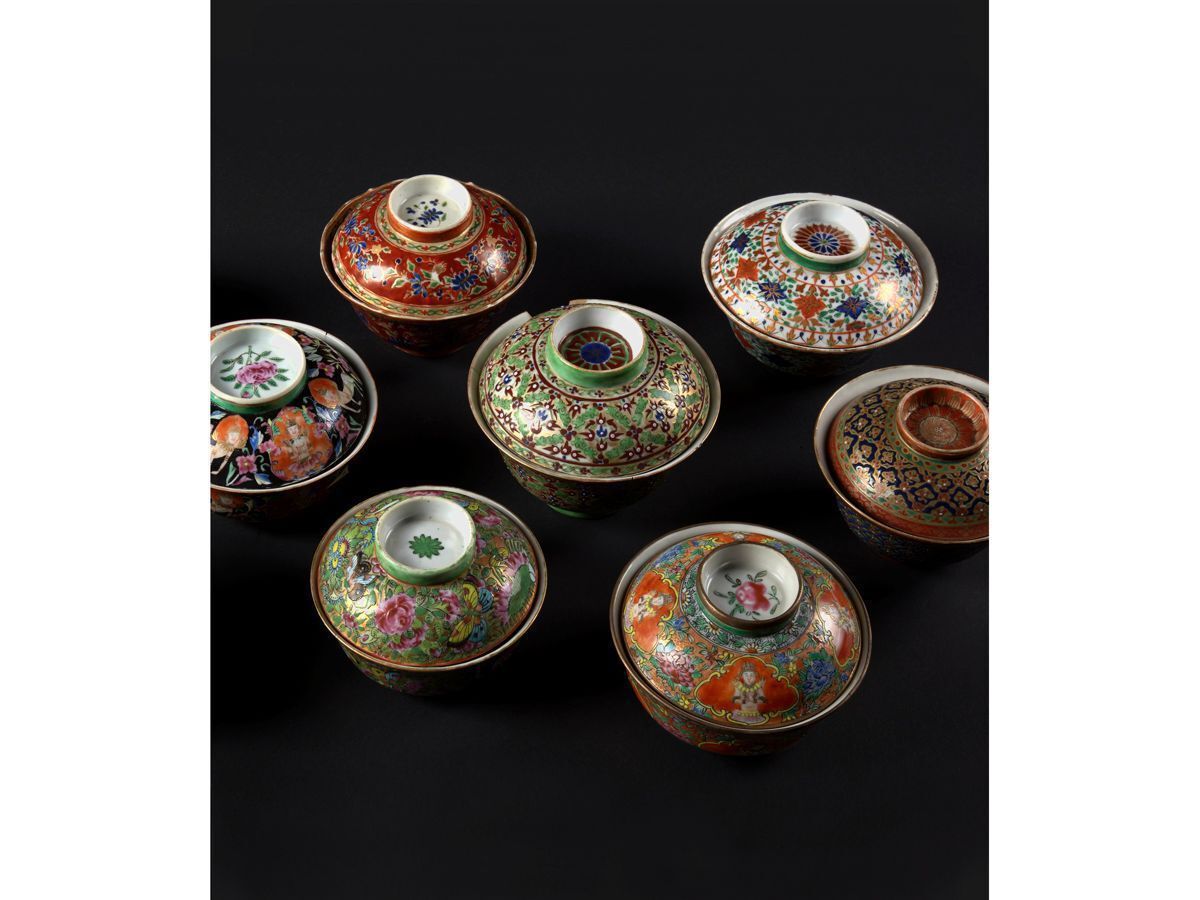
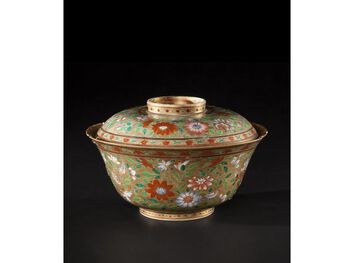
Benjarong with gold in addition to the enamel colors, was called Lai Nam Thong. The lids could be turned upside down and used as plates.
Photo: Kirsten J. Helgeland./Museum of Cultural History, University of Oslo
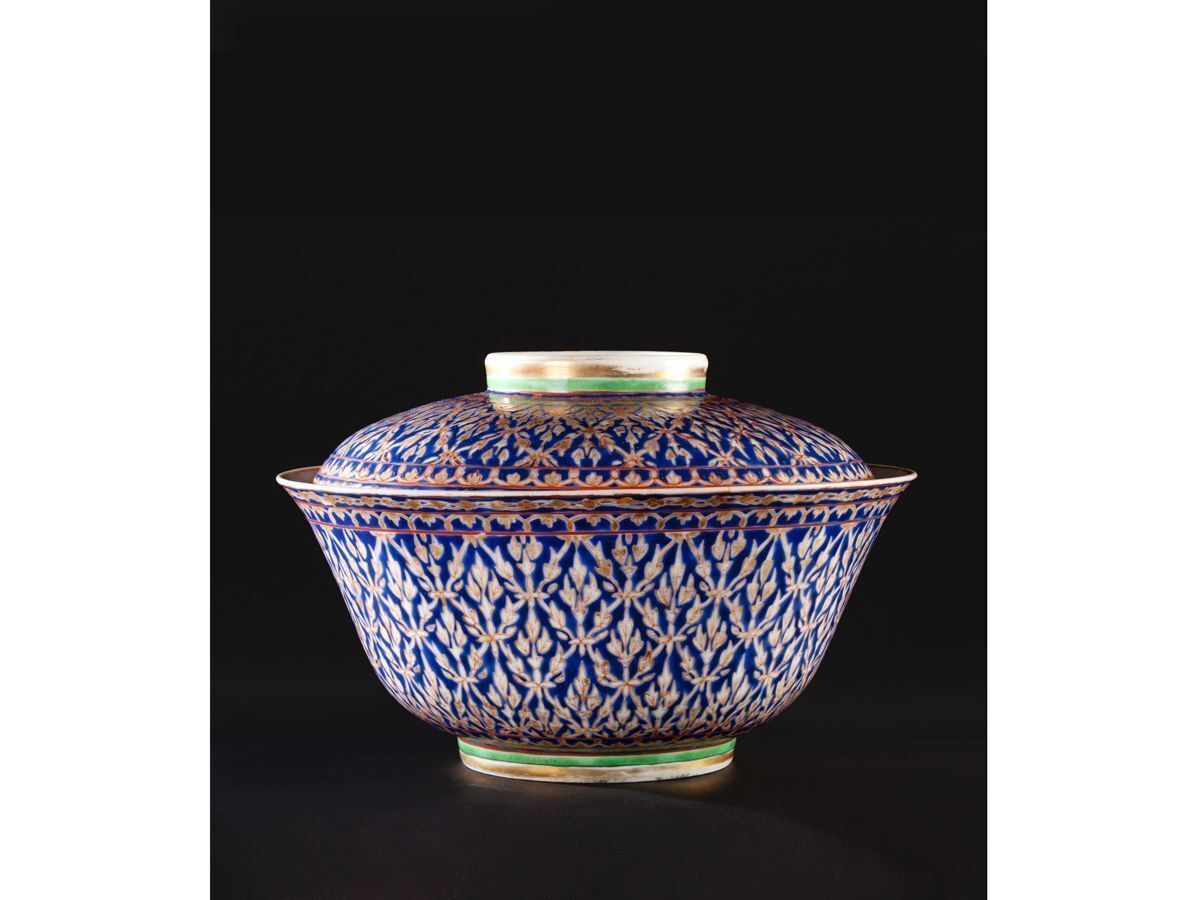
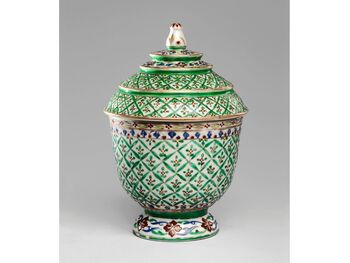
(UEM13000) The checkered pattern – like in a trellis - is popular on Lai Nam Thong porcelain, as on this bowl in blue, gold, and a hint of green.
Photo: Kirsten J. Helgeland./Museum of Cultural History, University of Oslo

(OK-06882) A large Lai Nam Thong bowl with beautiful blue and gold ribbons around the rim and base.
Photo: Photo: © National Museum/Frode Larsen

Serving platters were popular and used to serve fruit and other food. Serving platter from the Ring collection seen from above.
Photo: Kirsten J. Helgeland./Museum of Cultural History, University of Oslo

(UEM12926) Benjarong was utilitarian items. Jars with lids were filled with rice, savory dishes of meat, fish and vegetables, and sweet desserts.
Photo: Kirsten J. Helgeland./Museum of Cultural History, University of Oslo
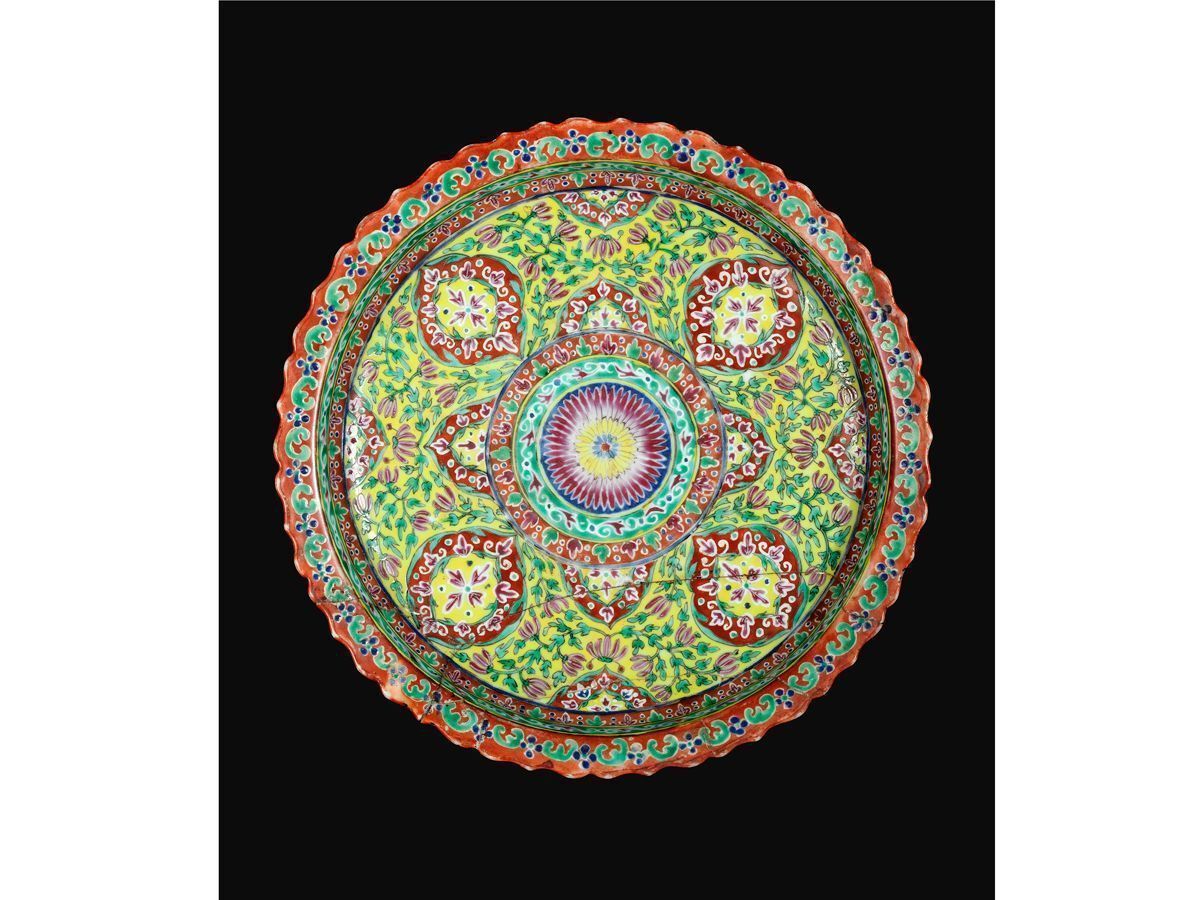
(UEM13027) Many floral motifs are inspired by Chinese culture. Here, a sumptuous chrysanthemum on an unusually large saucer.
Photo: Kirsten J. Helgeland./Museum of Cultural History, University of Oslo

These bowls have vertical, stylized lotus petals, which are in turn filled with floral motifs. The lotus represents awakening and the purity of the Buddha in our impure world.
Photo: Kirsten J. Helgeland./Museum of Cultural History, University of Oslo

(UEM12975,UEM12981) Jars with Chinese-inspired peonies. The rattan reinforcements indicate that Benjarong was made for everyday use.
Photo: Kirsten J. Helgeland./Museum of Cultural History, University of Oslo
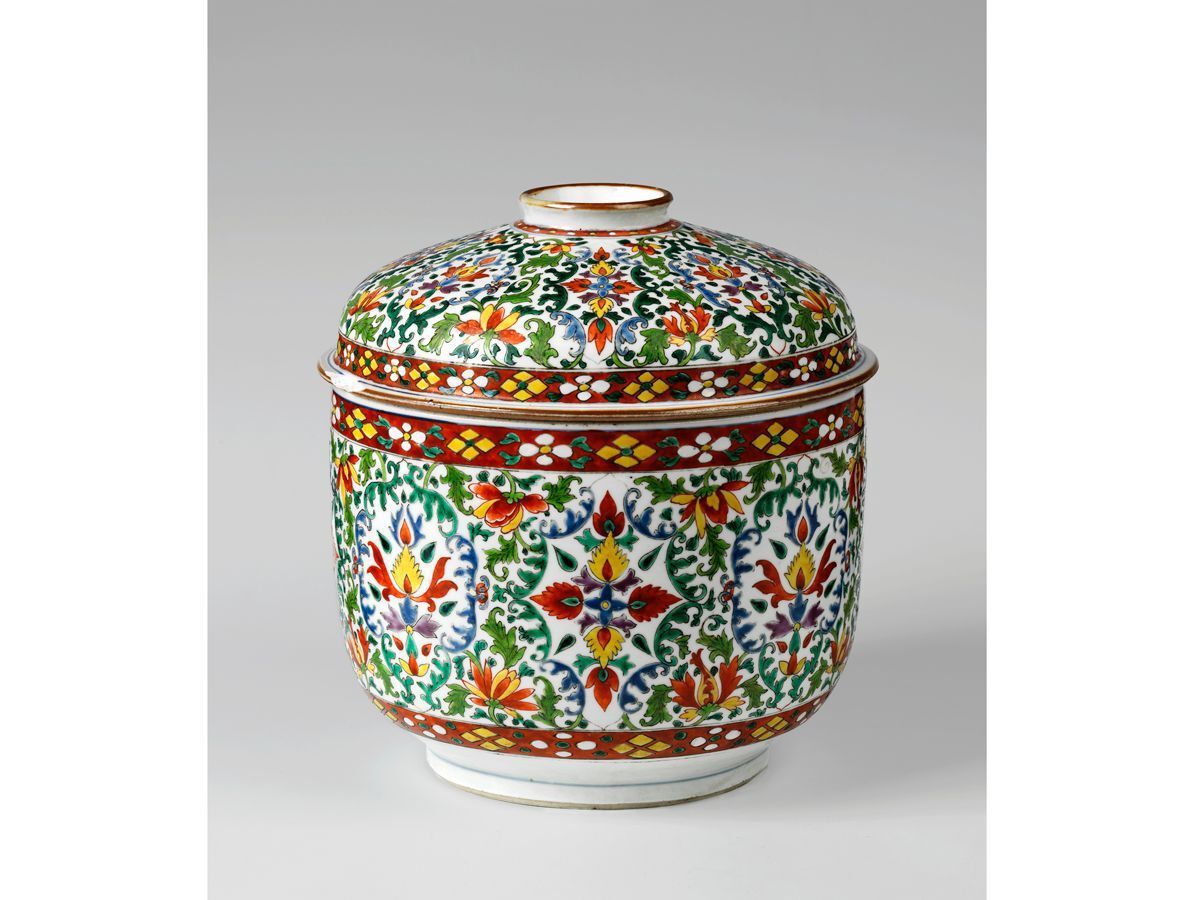
(OK-07717) A monk told Captain Ring that this large jar was used during weddings and cremations.
Photo: © National Museum/Frode Larsen
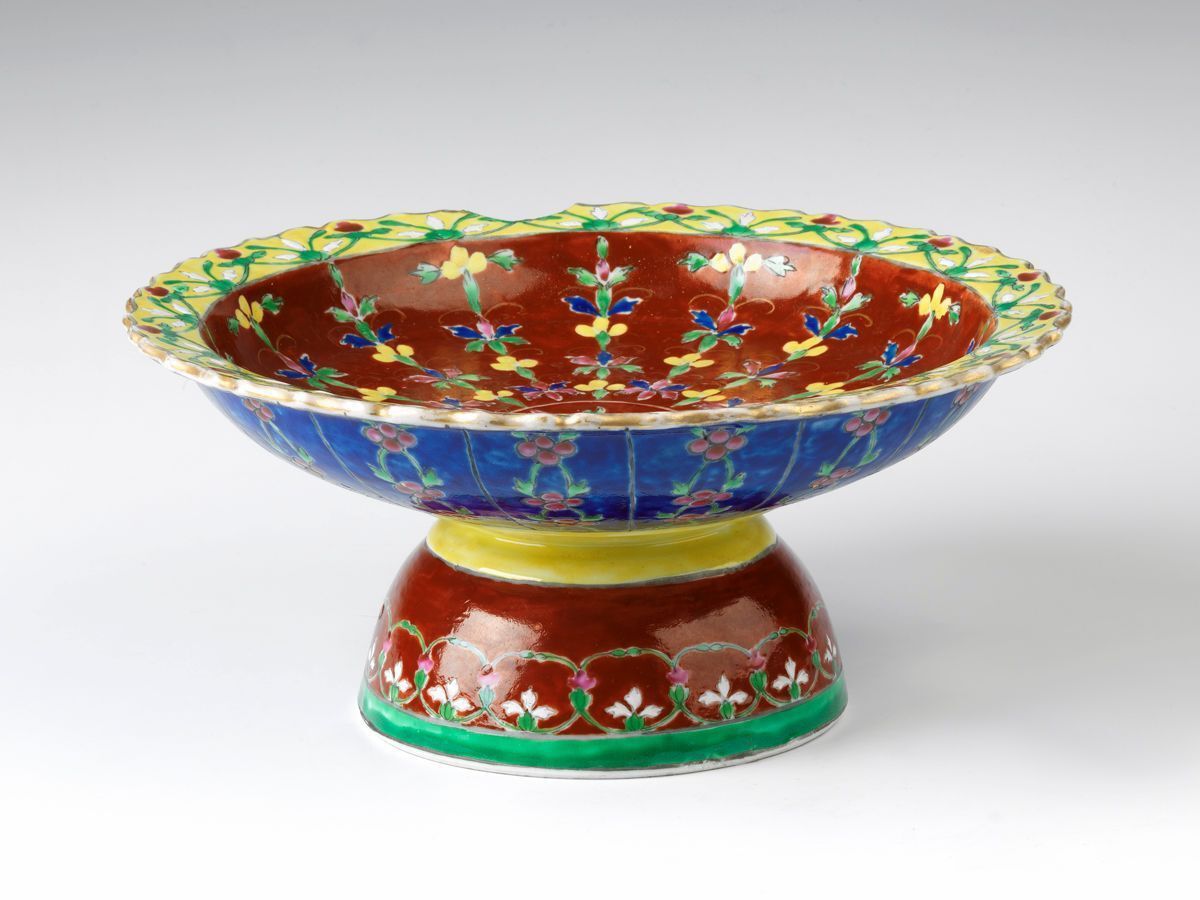
(OK-07718) The motif "Himaphan's Five Flowers" reminds us of the Indian roots of Thailand's mythology and artistic tradition.
Photo: National Museum/Frode Larsen

Tho prik containers for cosmetics or medicine. The gold lids were often decorated with precious stones or colored glass.
Photo: Kirsten J. Helgeland./Museum of Cultural History, University of Oslo

This small jar may have been filled with cosmetics and belonged to a princess or upper-class woman.
Photo: Kirsten J. Helgeland./Museum of Cultural History, University of Oslo

(UEM12998, UEM13002) Finely painted details and bright colors tell a story of the skilled craftsmanship that lays behind these Benjarong bowls.
Photo: Kirsten J. Helgeland./Museum of Cultural History, University of Oslo

(UEM12953) On this bowl the motifs are less symmetrical than usual on Benjarong, and are more reminiscent of Chinese taste.
Photo: Kirsten J. Helgeland./Museum of Cultural History, University of Oslo

Spoons decorated in both Chinese and Thai styles. People used the spoons to make their own soups, sauces and desserts.
Photo: Kirsten J. Helgeland./Museum of Cultural History, University of Oslo

(UEM12866) This unique bowl tells the story of Prince Phra Apai Mani, based on an epic written by the poet Sunthorn Phu (1786-1855).
Photo: Kirsten J. Helgeland./Museum of Cultural History, University of Oslo

(UEM14174, UEM14181) Captain Ring also donated enameled copper vessels with Benjarong-style decoration to the museum.
Photo: Kirsten J. Helgeland./Museum of Cultural History, University of Oslo

The museum has also received porcelain from Siam from another Norwegian, Carl Bock, who traveled to Siam in the early 1880s.
Photo: Kirsten J. Helgeland./Museum of Cultural History, University of Oslo


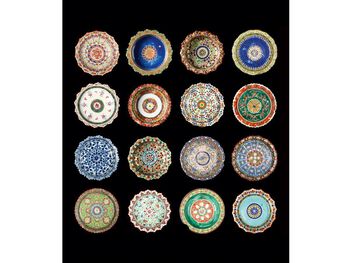






How was Benjarong made?
Benjarong was made in the same way as other enameled porcelain made in China. The desired shape, for example a bowl, was made by a potter, who turned it on a turntable. After drying, it was dipped in glaze, before being fired in a large ceramic kiln together with many hundreds, perhaps thousands of other porcelain objects. The kiln had a temperature of around 1350°C, so that the glaze would melt and adhere well to the porcelain clay, and the ware would become hard and strong.
The bowl was then painted with enamel, one color at a time. The enamel was made from a mixture of crushed quartz, lead oxide and pigment made from metal oxide, for example the green color was made from copper. After the measurement was finished, the jar was fired again, this time in a small circle, at a temperature of around 800–850°C. If gold was also to be used, this was added at the end, and the bowl was fired a third time, at a low temperature.
Captain Theodor Ring's collection
This collection was given to the museum in 1904 by Captain Theodor Ring. It consists of a total of 193 pieces, in all colors and patterns and shapes made of this special porcelain. A further 40 pieces are in the National Museum of Art, Architecture and Design.
There are many dozens of bowls with and without lids, in several sizes, the smallest only four centimeters high. The jars also come in many sizes, some of them are magnificent pieces, with beautiful colors and good brushwork. There are many saucers, some small and simply decorated, while the largest dish, which is almost 30 cm in diameter, has a detailed and intricate decoration. The group of small jars with gold tops is very charming. These were in the private rooms of the queens and princesses, filled with makeup, ointments, medicine, and small items.
Some of the objects are damaged, glued, or have been repaired with metal clips, but the vast majority are intact and of good quality. This collection is unique in both scope and quality. There are no known collections of this colorful and beautiful porcelain outside of Thailand today.