
The Myanmar objects were crafted from a diverse range of materials, such as wood, lacquer, ceramics, stone, bronze, brass, gold, silver, and plant fibers, reflecting both everyday life and ritualistic functions. Furthermore, the collection features a digital photographic archive comprising around thirty images taken by the Norwegian adventurer and trader Oscar Mamen, documenting his travels through Burma in 1923.


According to the available object descriptions, most of the items in the Myanmar Collection were acquired by the Museum of Cultural History through trade or gift exchange. However, there is a strong likelihood that certain artefacts, particularly those of a sacred nature originating from pagodas (Theravāda Buddhist temples), may have been removed from their original contexts under ethically questionable circumstances. These circumstances include war and conflict, as well as the colonization of the country.
The Three Anglo-Burmese Wars (1824–1885) resulted in the gradual incorporation of large parts of present-day Myanmar into the British Empire, first as a protectorate and subsequently as a colony. Several objects within the collection were obtained during this period and serve as material witnesses to a turbulent modern history marked by British imperial ambitions in the region. Most of the artefacts originate from the lowland areas of Myanmar and are representative of earlier historical periods, during which various Theravāda Buddhist kingdoms competed for power. In other words, the collection presents a narrative of two distinct contrasts: between the older Theravāda Buddhist history and the more recent colonial history, and between the highland and lowland cultures of Myanmar.
Two Selected Object Descriptions
An essential component of museum collections is the object descriptions that accompany individual items. Some of the objects in the Myanmar Collection have extensive descriptions of the context from which they were taken. One example is object UEM13946 (see the image gallery above). This small tin box, categorized as "means of magic, protection amulet", contains bird bones. Perhaps just as interesting as the contents of the box is the accompanying object description:
'The Burmese charm. Taken from the left arm a little below the albow in a very stout healthy Burnan [sic], said to be 10 years since it was inserted. He had three such in each arm on the inside at the side of the biceps muscles. These are believed by the natives of Burma to import the power of warding off bullets from the party having them, in other words that they are proof against fire arms, but unfortunately not against English bullets & now the delusion is very much out of fashion, since the country fell into the hands of the company. This one is said to have originally belonged to the head of some small bird that builds about the houses. Pieces of gold & even some of the precious stones of Burma are said by the natives to possess this power of preserving life. This little curiosity I with some difficulty got the wearer to permit me to cut out his arm (!) myself. He ceased to believe in its efficacy or money would not have tempted him to part with it. Dr. J. Reid. July. 12. 1854. Burma.'
This description sheds light on the sociopolitical upheavals in mid-19th century Burma. Besides providing a detailed first-hand account of the bird bones contained in the tin box and their use within a local context, it also gives valuable insight into Dr. J. Reid’s reflections on his collection of them.
Another example of an extensive object biography is found in the description accompanying items UEM42093/a-e, which together constitute a Buddhist altar (see the image gallery above). This story gives insight into the chaos that unfolded when Japanese forces, supported by the newly established Burma Independence Army (BIA), expelled the British colonial power from Arakan in 1942:
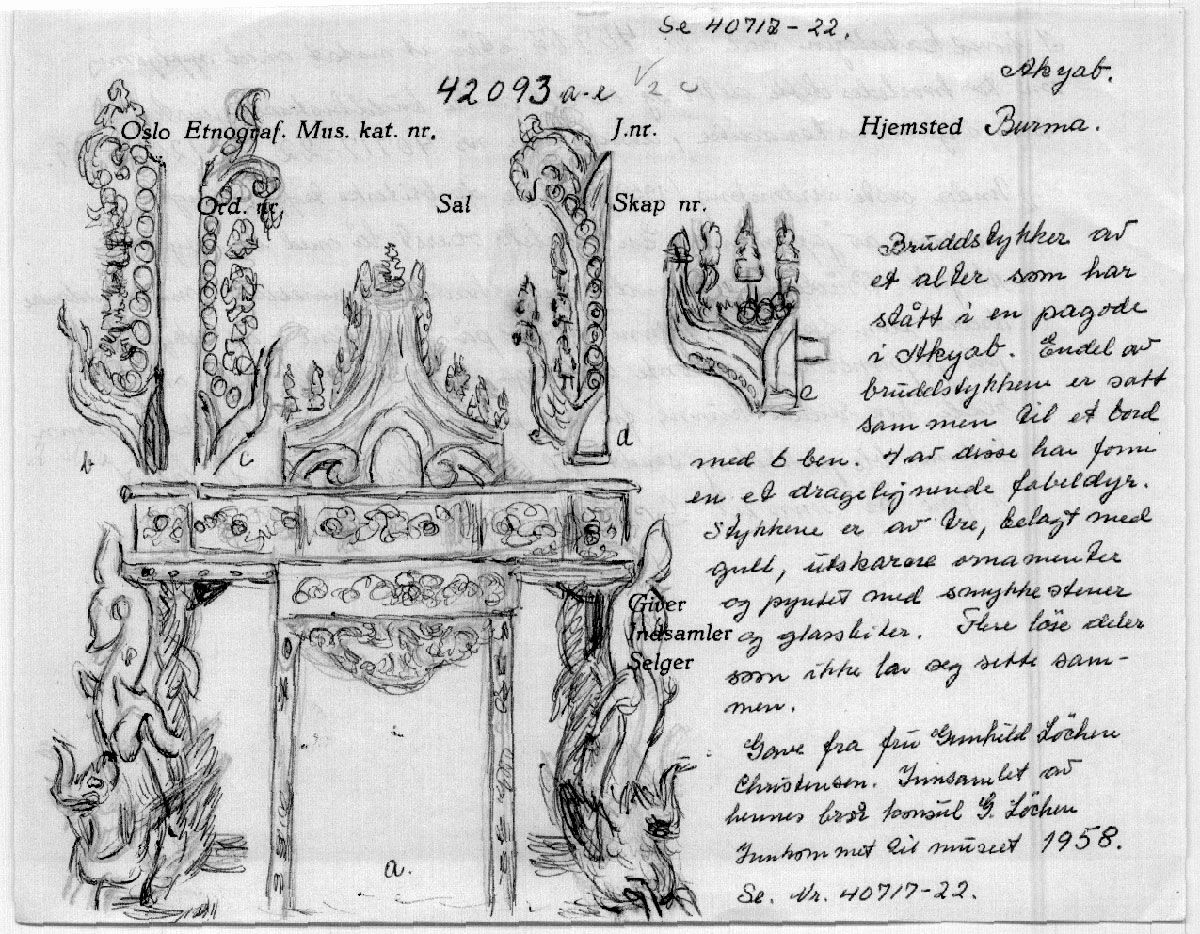
'During the last world war (1939–1945), British troops were pushed northward by the Japanese. An English colonel was stationed with his forces in Akyab. Both there and in other places, Burmese Muhammedans had taken up the practice of setting fire to pagodas – blaming the Japanese. The mentioned colonel gave his soldiers orders to save whatever could be saved from a pagoda that had been set ablaze. The items were packed and sent to Calcutta, where they remained in storage for several years until G. Löchen purchased the entire collection.' (Translated from the original Norwegian object description).
Theravāda Buddhist State Formation
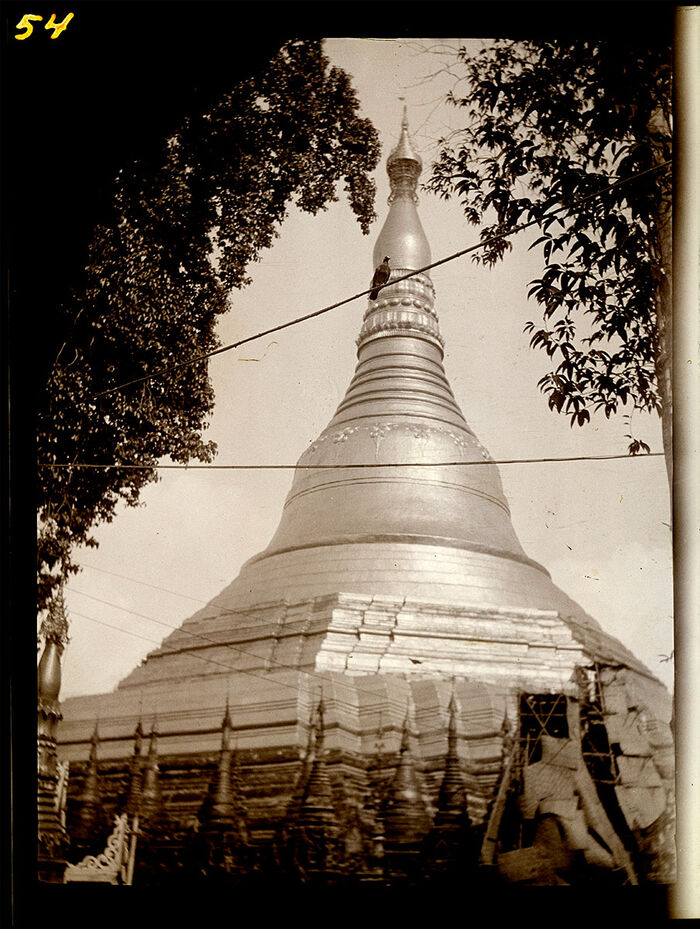
In addition to giving insight into colonial perspectives, the Myanmar Collection also provides a window into classical Theravāda Buddhist conceptions of authority and sovereignty. One possible interpretation of the objects is to view them as instruments of state formation, symbols and tools that served to legitimize and sustain political and religious power. Items such as umbrellas, Pali manuscripts, Buddha statues, and figures of kings and monks reflect notions of the Buddhist kingdom as described in the Pāḷi Canon or Tripiṭaka (the collection of Buddhist scriptures). The Shwedagon Pagoda, depicted above, is also an example of the material manifestation of Theravāda Buddhist state formation.
In contrast to the homogenizing processes of state formation in the lowlands, the highlands of Myanmar exhibit significant cultural diversity. Scholars such as Edmund Leach and James Scott have argued that these highland cultures embody a form of dynamic flexibility. Scott has further suggested that this flexibility functions as a deliberate counterweight to state control and centralized dominance in the lowlands. The contrast between the state-building symbolism of the lowlands and the highlands’ resistance to state integration illustrates the ethnic and political complexity of Myanmar, a country officially comprising 135 different ethnic groups. Myanmar has been ravaged by civil wars for over half a century, something which can be seen as a testament to the deep internal divisions among its population.
References
- Leach, E. R. (1964). Political systems of highland Burma: A study of Kachin social structure (Reprinted with a new introductory note by the author). London School of Economics and Political Science.
- Scott, J. C. (2009). The art of not being governed: An anarchist history of upland Southeast Asia. Yale University Press.
- Skidmore, M. (Ed.). (2005). Burma at the turn of the 21st century. University of Hawai‘i Press.
- Spiro, M. E. (1982). Buddhism and society: A great tradition and its Burmese vicissitudes (2nd expanded ed.). University of California Press.