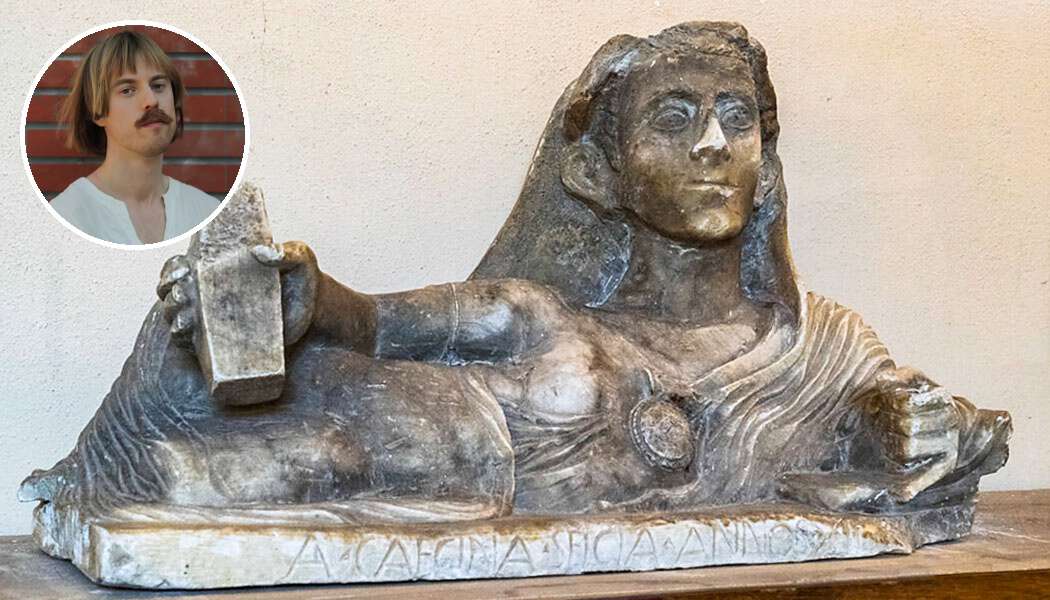
The article draft is based on Söderströms MA thesis and the aim is to answer the following questions:
(I) Why Aulus Caecina wrote his work on the Etruscan discipline, known to the Romans as the De Etrusca Disciplina.
(II) What the work can tell us about the use of Etruscan lore in the late republican period and Caesar’s civil war.
Additionally, the article serves as the first complete commentary and analysis of all fragments of Aulus Caecina’s work. Scholars have taken an interest in Aulus Caecina and his work since at least the 19th century. Excellent work has also been done in more recent years, both on him, and Etruscan divination in general. However, much of the scholarship concerning Caecina's literary work can be said to have been somewhat unfocused. In relation to this historiography, this dissertation makes some new interpretations, but also reinforces certain old ones.
This paper aims to give the author his proper due, by (I) providing both a biography of his life, and (II) a first ever full commentary and analysis of his work. It also explores the work from new angles (III), with theoretical frameworks that have yet to be used in the reading of Caecina. That includes ‘epistemicide’ and ‘cultural translation’. I argue that seeing Caecina’s work in these new frameworks can be rewarding in terms of our understanding of the work and the aims of its author.
By these methods, this paper argues that Aulus Caecina was concerned for the survival of Etruscan epistemology, and sought to translate his native systems of knowledge to Latin to guarantee its survival. The work is a testament to the threat that Roman imperialism could pose to native epistemology. At the same time, the surviving fragments attest to the opposite, that Roman intellectual circles also contributed to the survival of the work. Seeing his literary output in relation to his political activities as a member of the Pompeian faction in Caesar’s civil war, it is also argued that he was concerned both for the Roman republic, as well as the integrity of his homeland in Etruria, both of which were under threat during the many upheavals of the late Roman republic. In this regard, it is argued that ‘cultural self-defense’ is a rewarding framework to understand Caecina’s aims when he wrote the work.»
Emil Varjord Söderströms hovedfokus er Romerriket, først og fremst romersk republikansk tid. Innenfor dette temaet har han vært mest interessert I kulturhistoriske vinklinger, mentalitetshistorie, religion, og epistemologi. Han har tidligere studert Plautus' teaterstykke Poenulus, og hva det kan fortelle om romernes oppfatning av kartagere. Artikkelutkastet som diskuteres i CLARA-kretsen er basert på hans MA-oppgave, som er en kommentar og analyse av fragmenter av et romersk litterært verk om etruskisk spådom via brontoskopi, dvs. observasjon og tolkning av lynnedslag.
Arrangementet krever forhåndspåmelding.
Kontakt: Faglig sekretær Sofia Hammervoll. E-post: s.m.l.hammervoll@admin.uio.no