Spiritual gain
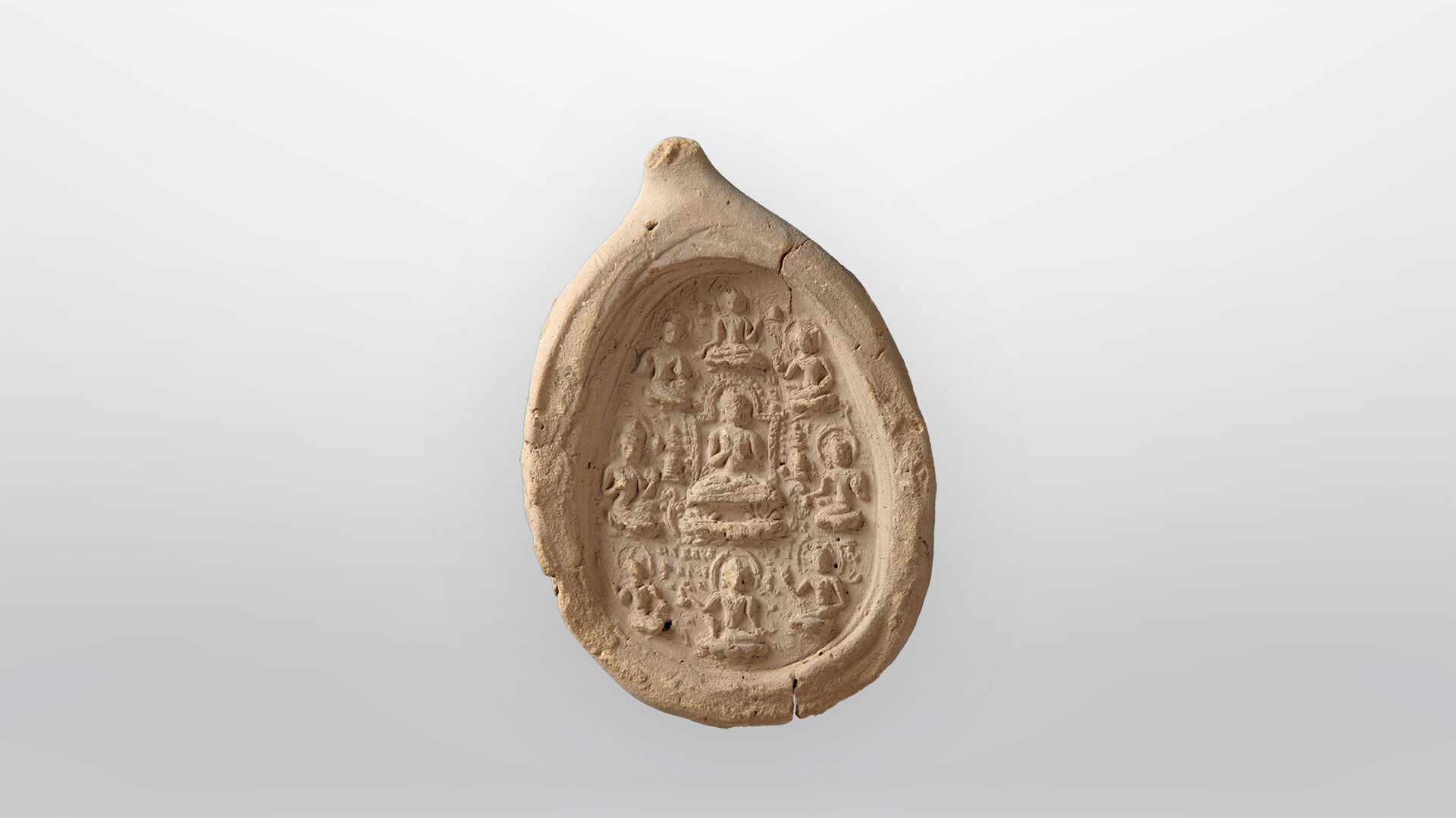
Tablets served as a focal point for religious meditation and were supposed to give spiritual gain if one sacrificed them. The image of the Buddha protects and blesses, and the more tablets that were sacrificed, the greater the spiritual gain. Tablets were made by pressing clay into a carved form of wood or stone, before they were burned in simple circles. A mold could be used to make perhaps a thousand tablets before the carved motif wore out. This meant that they could be mass-produced.

The back of one of the tablets shows three ye dharma stamps with text in Sanskrit (UEM11031).
Foto: Eirik Irgens Johnsen/Museum of Cultural History, University of Oslo

Buddha sitting on a lotus. The throne on each side has a pillar with a goose on top. The Buddha has a halo, the left hand is in the lap, while the right hand touches the ground (UEM 11043).
Foto: Eirik Irgens Johnsen/Museum of Cultural History, University of Oslo.

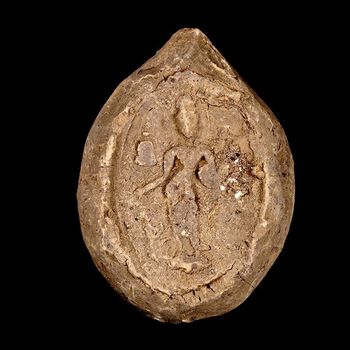
Standing 12-armed Avalokiteśvara, a bodhisattva (enlightened being) who encompasses all the compassion of the Buddha. Avalokiteśvara stands on a lotus, his legs flanked by two small figures. The tablet has some cracks (UEM 11031).
Foto: Eirik Irgens Johnsen/Museum of Cultural History, University of Oslo.

Standing Avalokiteśvara. The tablet is worn, and it is difficult to see the details (UEM 11029).
Foto: Mårten Teigen/Museum of Cultural History, University of Oslo

Seated Avalokiteśvara with four arms. Writing on one side of the figure (UEM 11041).
Foto: Eirik Irgens Johnsen/Museum of Cultural History, University of Oslo.

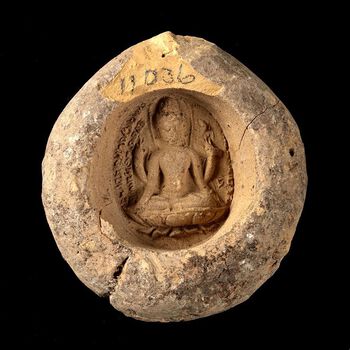
This clay tablet is small, only 7.3 cm long, but thick, with a deep stamp and clear details. It shows Avalokiteśvara with four arms, and an oval halo, sitting on a double lotus. Vertical writing along the side. The tablet has a chip at the top and cracks (UEM 11036).
Foto: Eirik Irgens Johnsen/Museum of Cultural History, University of Oslo

Unidentified male figure, possibly a bodhisattva. The figure is seated in a position called «royal ease», and sits against a pointed, richly decorated throne (UEM 11034).
Foto: Mårten Teigen/Museum of Cultural History, University of Oslo

Unidentified male bodhisattva, with halo and crown, right foot resting on a lotus pedestal. (UEM 11042).
Foto: Eirik Irgens Johnsen/Museum of Cultural History, University of Oslo

Copper plaque that was used as an offering, with a relatively crudely carved Buddha figure (UEM 11018).
Foto: Mårten Teigen/Museum of Cultural History, University of Oslo





Out of the caves
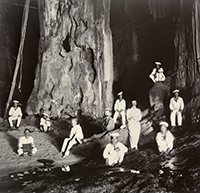 A cave in the province of Trang, south of Phuket, which Captain Ring visited with family, friends and crew.
Theodor Peder Amundsen Ring from Solør in Norway was a captain in the Royal Siamese Navy at the turn of the 20th century. He was a collector and bought objects that he later donated to the Ethnographic Museum, which is now part of the Museum of Cultural History.
Captain Ring bought the clay seals on one of his voyages in service of the Siamese Navy along the west coast of the Malay Peninsula. He says that they were found in a cave under a layer of bat guano, which is why they were wet, as if they were newly made. The locals therefore believed them to be made by spirits and did not dare to enter the caves.
Ring further explains that the Chinese pepper planters in the area had a need for the guano, and therefore made «short Process both with Guano, Figures and Superstition». It was probably the pepper planters or some local Siamese who sold the sails to Captain Ring, which he later donated to the museum in 1906. These clay sails were made in the 9th-10th centuries, and this type is rare to find, both in Thailand and elsewhere.
At the same time as the tablets, Theodor Ring donated 14 metal plates with engraved Buddhist figures, which probably date from the 19th century.
The collection of clay tablets is described in the article written by Peter Skilling: «Molding merit, distillation of the Dharma: Curiosity and curios in the age of collecting» in the anthology Royal porcelain from Siam. Unpacking the Ring Collection.