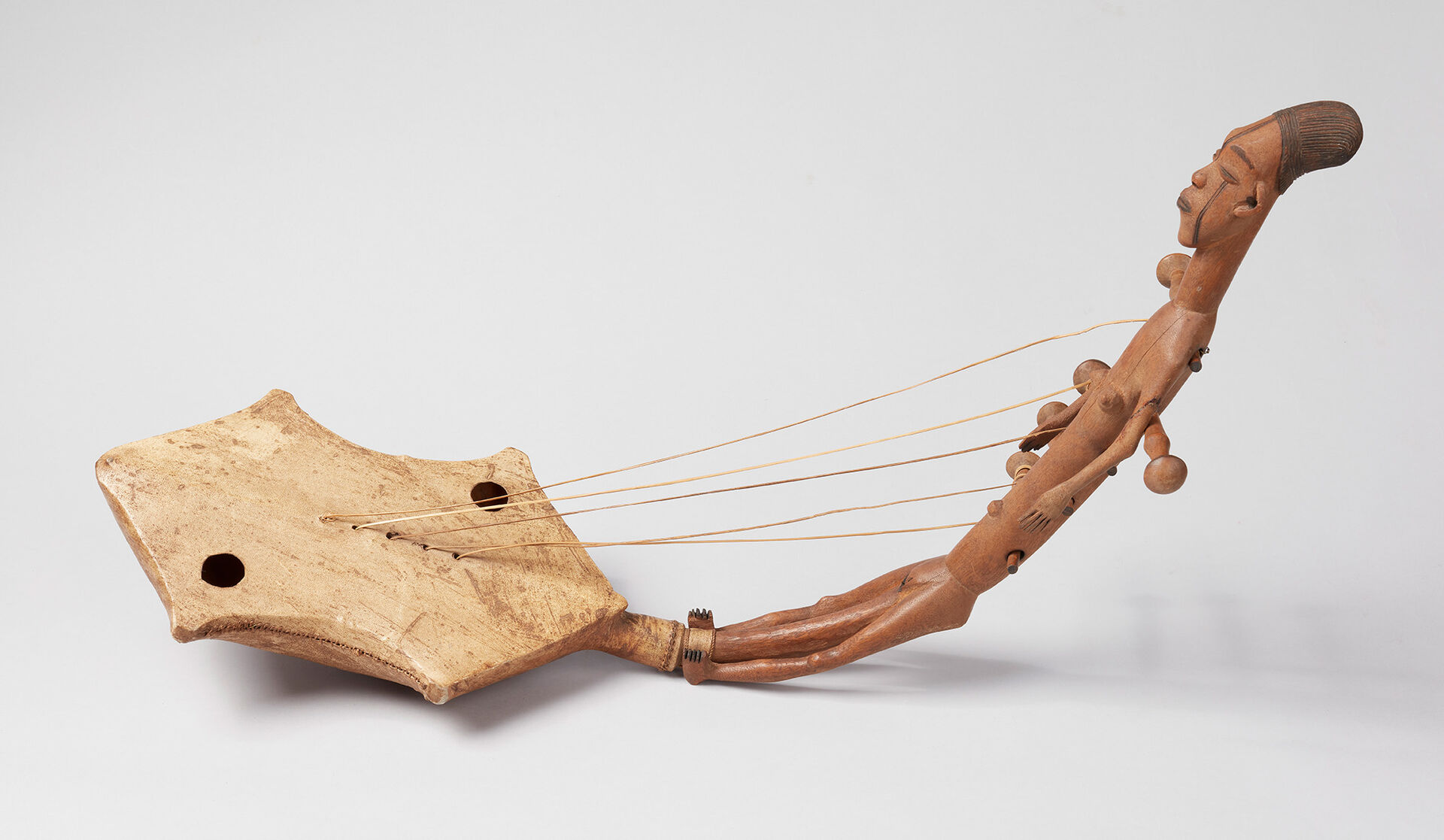
Anthropomorphism refers to the phenomenon of attributing human form to objects and entities. The process through which human qualities are attributed to objects encourage our understanding of sociocultural diversity, including our relationships with the spiritual and non-human realms. Our human propensity towards anthropomorphism, a commonly shared human inclination, stimulates our motivation to form connections, even with what in different societies are considered invisible entities, and as such, it provides a sense of comfort and control.
The artefacts presented here are all made in human-like form. They are simultaneously tools and symbolic objects with spiritual dimensions from different regions of Central Africa. The anthropomorphic objects are thus practical instruments, such as a chair, a comb, a hat, a string instrument, an amulet, and medication. They all incorporate aesthetic and spiritual value.


The museum’s Congo collection is primarily a cultural and historical collection. Most of the objects are donations from Norwegian men and a few women who served in the Belgian and French colonial administrations or acted as business travellers, sailors, and missionaries in what was then referred to as ‘Congo’. More recently, the collection has been supplemented by artefacts donated by men and women working in the Norwegian Foreign Service and by researchers in the field of anthropology, who, during their ethnographic fieldwork, identify artefacts eligible for research, teaching, and museum professional purposes. The collection is constantly growing.
The museum’s Congo Collection includes artefacts from various parts of Central Africa, that is, the Republic of Congo/Kongo-Brazzaville, the Democratic Republic of Congo/Kongo-Kinshasa, as well as the bordering regions of Gabon and Angola. The Republic of Congo was known as the ‘French Congo’ from 1880 to 1908. From 1910 to 1960, it was part of French Equatorial Africa along with Chad, Gabon, and the Central African Republic. The Democratic Republic of the Congo was formerly known as the ‘Congo Free State’ from 1884 to 1908, ruled by King Leopold II of Belgium, and later referred to as the ‘Belgian Congo’ until 1960. Hence, what the museum refers to as the ‘Congo Collection’ consists of historical objects from what today constitutes several different nation-states in Central Africa.
To increase public accessibility to the museum’s ethnographic collection, we offer both physical and digital presentations showcasing objects kept in the museum’s storage. The museum further welcomes collaboration with the public to expand and develop a shared understanding of the historical objects and the societies in which they were once created and used.
The documentation of the displayed objects draws mainly on the museum’s own catalogue and archival sources.

More about Congo and the Museum of Cultural History
- Exhibition ´Congo Gaze', 2016
Objects from Congo in the museum database Unimus
Literature
- Vogel, Susan. 1989. "Africa and the Renaissance: Art in Ivory" in African Arts, Vol. 22, No. 2, pp. 84-89+104.
- MacGaffey, Wyatt. 1988. "Complexity, Astonishment and Power: The Visual Vocabulary of Kongo Minkisi" in Journal of Southern African Studies, Vol. 14, No. 2, pp. 188-203.