Weaving and use of the traditional garments
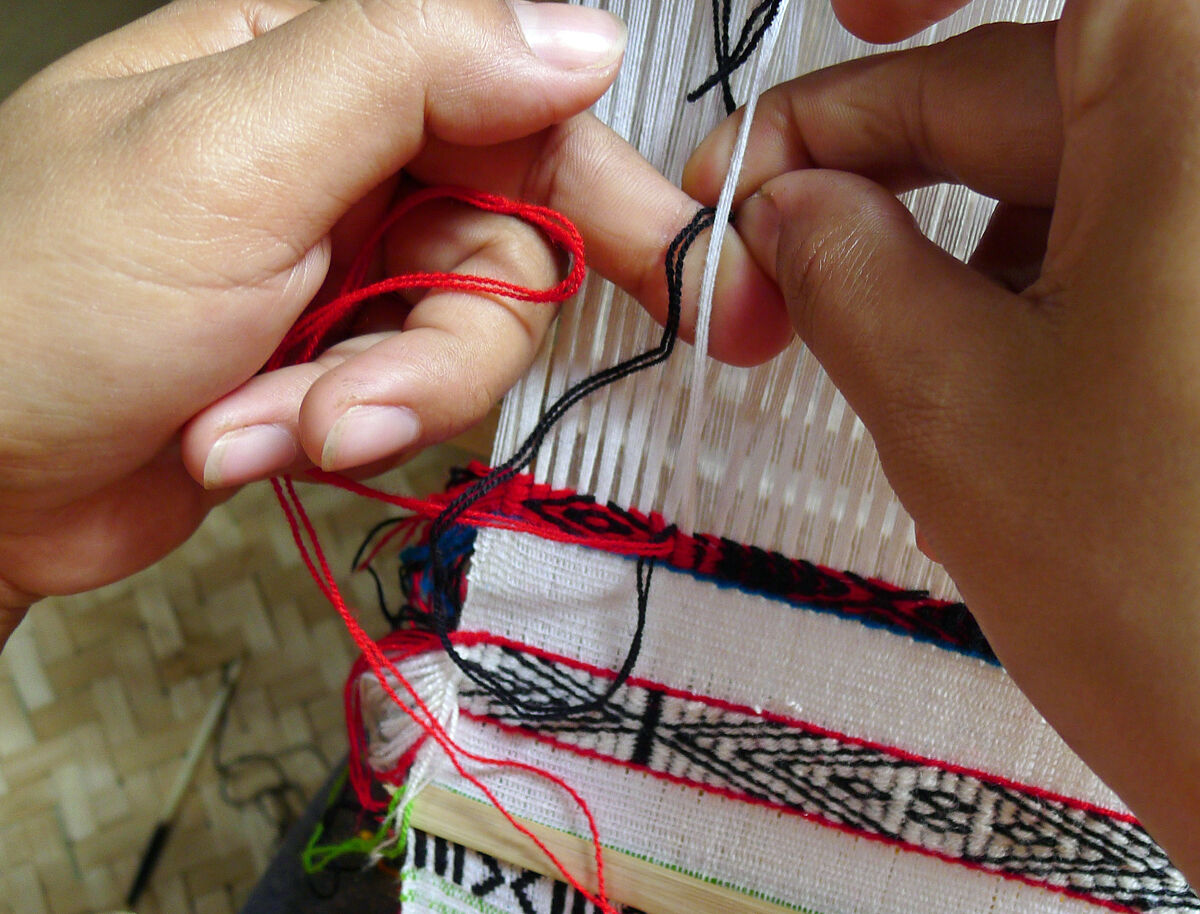
Weaving is done at home in between all household chores and work in the fields. From an early age, girls learn by watching their mother or other women weaving. The girls can put up their own loom by copying their mother, elder sister, an aunt, or grandmother. Young girls who enjoy wearing nice attires have a special motivation for weaving. Often, they became important weavers for supplying clothes to the whole family. A young girl was evaluated for her weaving skills. Though there are variations in interest and skills, nearly all women know how to weave.
In the emerging urban centres, girls are taking higher education and less women are weaving.
The local materials
In the villages, cotton and eri-silk (honki) is still hand-spun using a spindle (as of the 1990s), but to a lesser extent than before because synthetic yarn has become more common. Silk used to be an important home production. The silkworm was kept and cared for in special trees called: a) Inki-an, b) Sangkrung, and c) Hanjor. The cocoons were boiled before the threads could be extracted. In Northeast India, eri silk is widespread. Unlike other silk fibres that are filaments, eri fibres are short and produce a softer, fuller texture when spun, making fabrics made of eri silk warm to wear. These fabrics are worn on cold days by both men and women. Today, due to the availability of acrylic yarn, eri silk is not used as much, but it is highly valued. The silk pupa is considered a delicacy to eat. From the 2020s onwards, the demand for eri silk garments is increasing again, but it is difficult to obtain enough raw material.
In Karbi society, one can occasionally see pekoks woven in muga silk/wild silk geographically linked to Assam. Muga silkworms are reared in Karbi Anglong and the silk has a natural golden hue with a glossy texture. However, main area for weaving garments in Muga is in Sualkuchi, a village area a little south of Guwahati that specialises in silk production and weaving. This area supplies the entire northeastern part of India with silk products specifically made for the various cultures. For example, the Khasis get their women's silk dresses woven here. In Assamese culture, muga has had a special status since the Ahom rule. It is said that silkworms can only be reared in the special soil of Assam muga. Muga is therefore seen as a symbol of identity. In Assamese culture, the bride receives a certain number of mekhela chadors from the groom for the wedding, and at least one of these must be in muga.


How paddy and cotton came to earth
Sok (paddy) and Phelo (cotton) were both daughters of Songsar Richo and resided at Sining Angsong (above the skies) with the other gods. From above, they could see what was going on on earth. Sok saw that Karbi people would only forage from the forest and filled their stomach with leafy greens (bap-bi angkor) like choseot, lok ple-ple and thengpi angkur (root of plants) like ruidok, phurui etc.
Seeing the plight of the Karbi people on earth, she had told her father, Sot Richo, to ask for permission to descend to earth and take care of the Karbi people so that they have better things to eat. Hearing this, Phelo said that just feeding their stomachs will not suffice, they should also have clothes to wear to cover their bodies with; Let me go along with my sister to earth and I will take care of their clothing. Songsar Richo agreed, but he had one condition for both of his daughters. They could descend to earth and take care of the Karbi people, but once their job was done, they would have to return; they were not allowed to stay for long.
Serdihun Atomo (The story of Serdihun)
Serdihun Timungpi (Phangchopi) is considered to have been the first individual amongst the Karbis to ever learn to weave motifs (amang keitur) on traditional Karbi garments.
It is believed that a long, long time ago, the Karbi people had very limited clothing options. They were all very plain and basic. They would wear clothes only to fulfill their basic clothing needs; they were unappealing with no charm. The gods above the clouds saw this and thought that the Karbi people should have beautiful clothes as well, so they decided to bless Serdihun with artistic talents and gave her the idea to weave motifs onto those plain unappealing clothes. According to one of the verses in Serdihun Alun (Serdihun’s song), she had a knack for weaving with the loin loom from a very young age and was very well known for her talent. The first motif that she had woven was on a wamkok. After seeing her work on the wamkok, the men also asked her to weave something for them, so she wove a poho for the men with a motif called poho amang on it. Later, she went on to weave Pini where she wove aphidop amang, peh jang-et on pekoks etc. Aphidop is believed to be the oldest motif woven on a pini.
Serdihun Alun ( Serdihun’s song) is like a life history of Serdihun Timungpi, depicting different phases of her life sung in different rhymes. The song has 30 different verses depicting different phases of her life.
One example of the text in the verses:>Serdihun asks her father Punja Timung to make her a hon-lam (an instrument used while making thread); her father then cuts the Bengvoi plant to make wood for her hon-lam. He then carves the wood into a hon-lam.
Garments with motifs and singing in the Chomangkan ritual
During the Chomangkan, a small effigy of straw is made of the dead person. This effigy is equipped with all the necessary garments in miniature size. At the gate of Chom Arong, the spirits residing there are welcoming the new coming spirit. Through Charhepi’s song, they will ask what the newcomer is bringing, they will comment on the garments and ask which motifs are woven. In the verses, the names of the various motifs are listed.
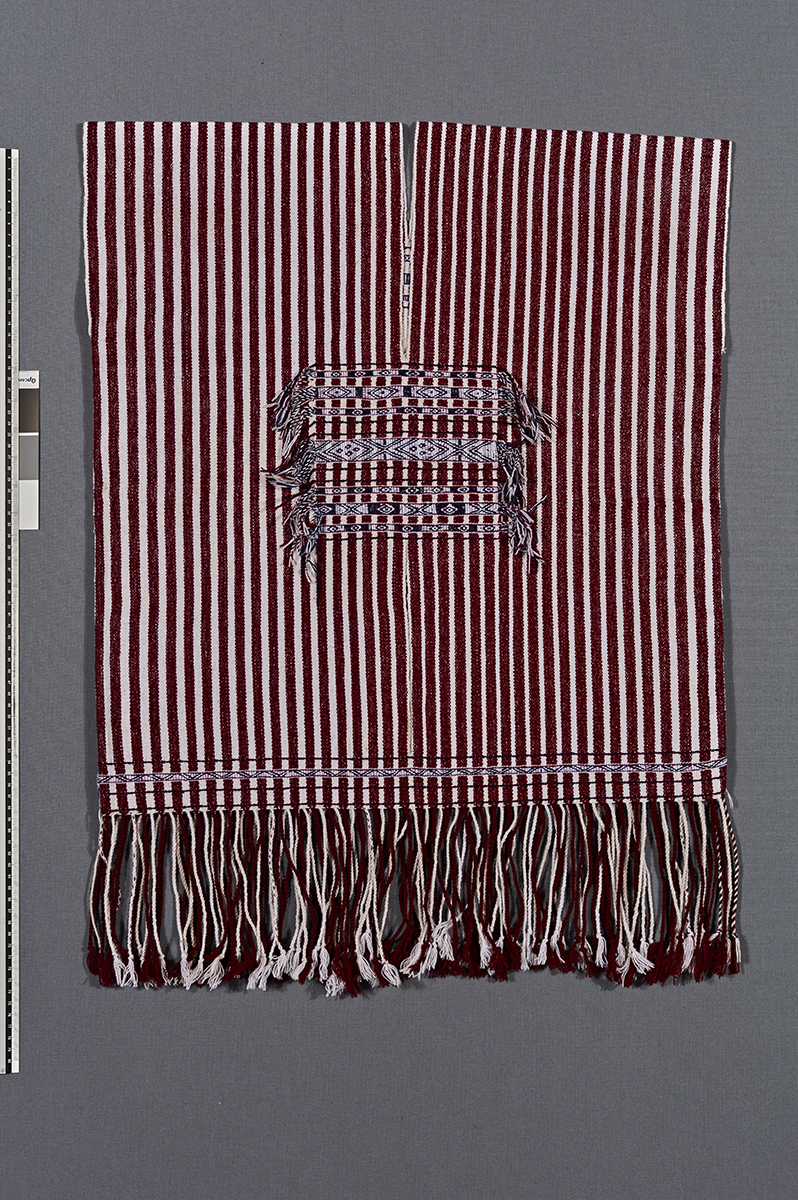
The motifs used in the sheets pelu, pini-ku and women’s wrap skirt, pini, have a special importance. These motifs often appear more as signs and symbols than figurative. They are like the feet of the caterpillar or gecko, the web of the spider that protects the home etc.
The garments, a short explanation of the vocabulary
Peh means a cloth. Kekok means to tie a knot. Pekok is a cloth (garment) with a knot. This is an umbrella name for various garments.
Seleng: Originally, this was a white garment with some motifs to cover the head of the bride during the wedding (Adam Asar). Later, it has become the term for a garment with borders and small motifs scattered all over.

The short version of Seleng is called Seleng a Pekok. Now used by women at almost all occasions and only called Pekok.
The long version of Seleng is called Seleng Kiding. This piece of cloth can be draped in various ways, looking like different garments, and is used at certain events and rituals.
Pini is a garment worn by Karbi women on the lower body like a wrap skirt and kept in place by tying a wamkok. It reaches the calves from the waist and is also called Pini kamplak.
All the pini of the past used to be dyed using traditional dye, the sibu leaves (indigo). The pini is typically dyed after it is woven, but some dye the thread as well before it is woven and continue the dyeing process afterwards. Later, coloured thread was available in the market. (See objects: 46842 – 46848).
Wamkok is generally worn along with pini-kamplak and is part of Karbi women's traditional attire. Literally translated, Wamkok means; wam- waist and kok- to tie. It is a type of belt tied around the waist to secure the pini in place.
Wankoks have changed according to the fashion of matching the pekok, in the 2020s, the original white ones are more in use again. The tassels at the ends known as Abu come in different variants and have gone through similar changes (see objects 46849 – 46853).

Poho, muffler and headdress
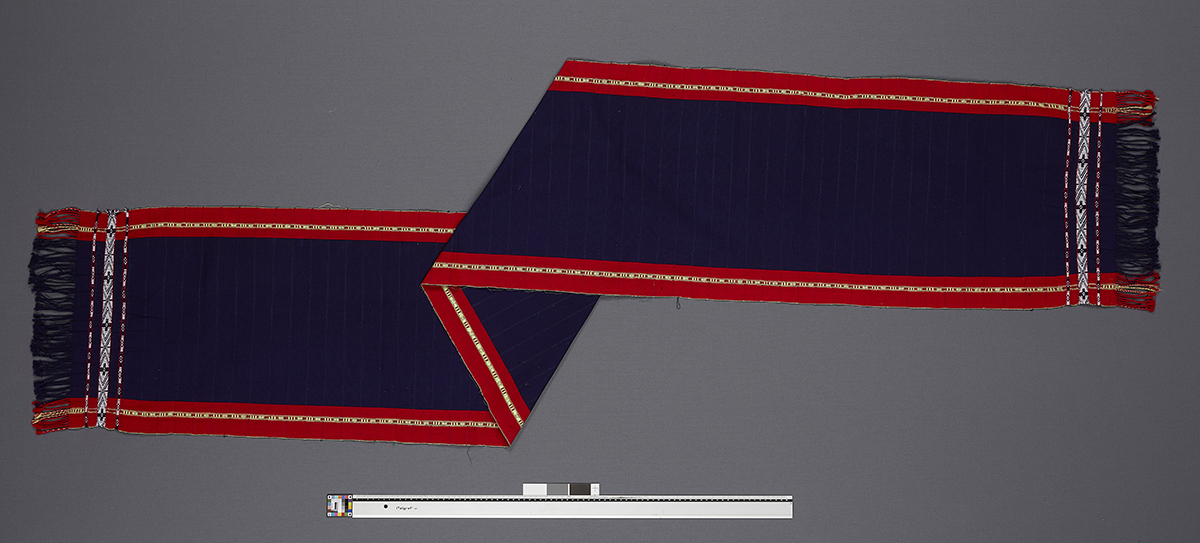
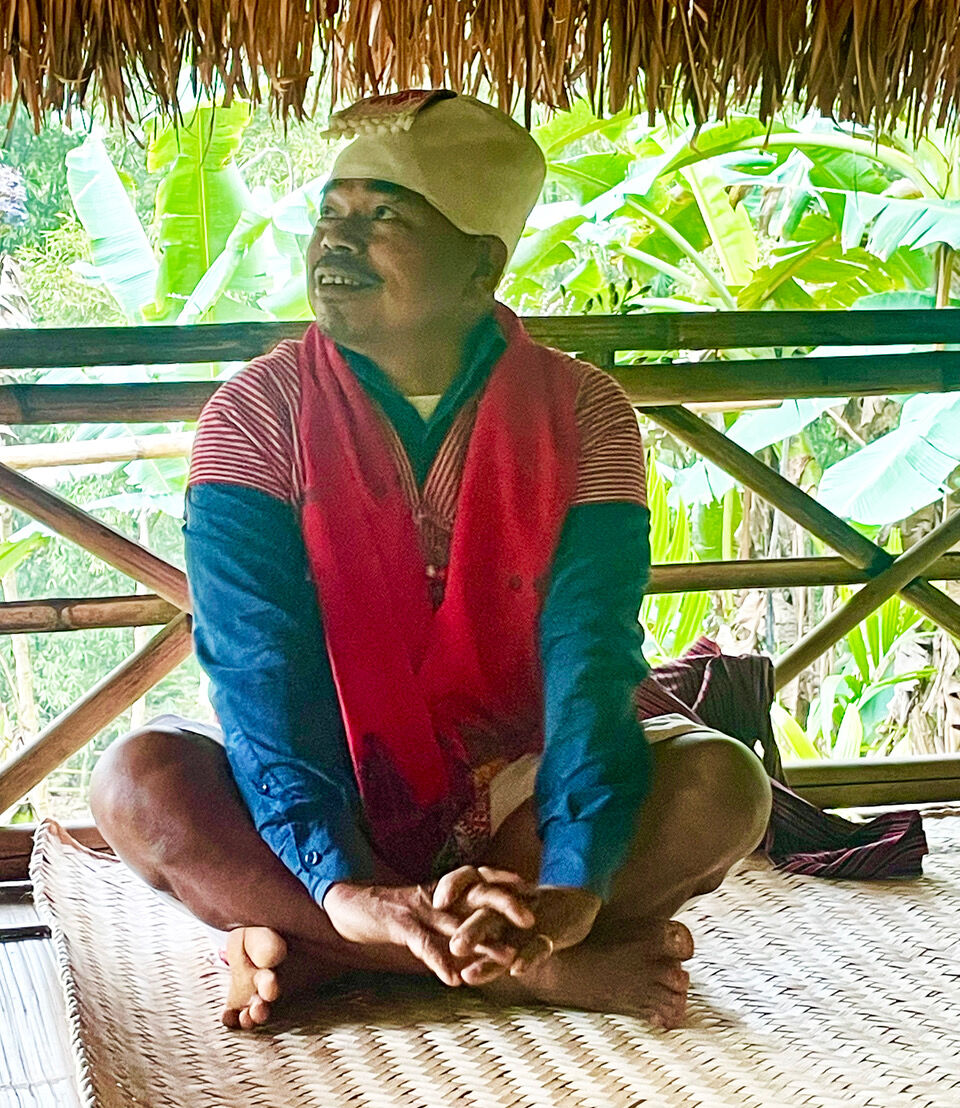
Used by married and unmarried men daily and on special occasions like festivals, rituals, wedding etc. The colour shows the social status of the wearer, white for the unmarried and red for the married.
Pohos are often intricately woven and are a cherished gift from a wife, sister, fiancée etc.
Motifs and their colours had local variations distinct to a region or village. In recent years due to more interaction across Karbi Anglong, motifs have become similar and are less distinct in terms of representing a certain region.
When a respected person is welcomed to a house or being honoured, a poho is laid around the neck of the person. Seeing as white and red ones are reserved for men only, something was needed for women in order to show respect in the same way. A recent “invention” are the striped ones reserved for women, named Peh sarpi a poho, object 46889. The models are the striped shawls used by women.
For men’s pohus, see objects: 46877, 46879- 46881, 46884- 46888.
Choi: For men, worn on the upper body. Colours show social status. (See objects 46891 – 46895).
Motifs
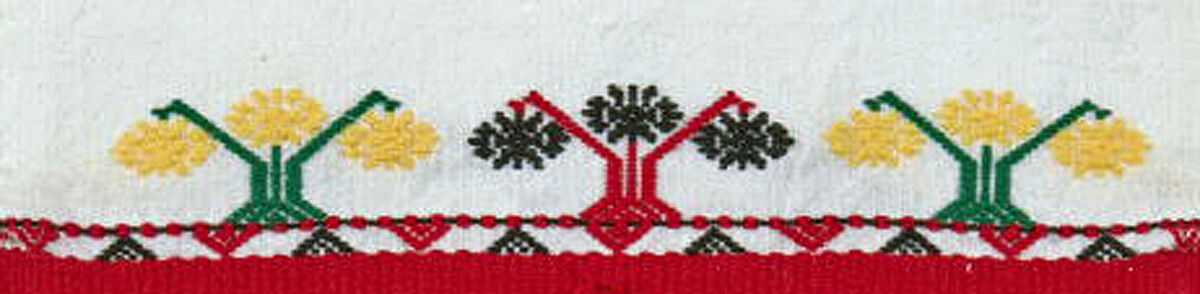
Almost all motifs and borders can be used on any occasion, the only exemption is the Phongrong ángsu, a small apple-like fruit with thorns on it. The story goes that a lady stepped on it and got a thorn in her foot. She then looked more carefully at Phongrong ángsu and made a motif for the loom.
The motif became very popular, but garments with Phongrong angsu are forbidden to be worn on the dead body. The body of the dead must wear Karbi traditional attire during the funeral rituals. It is believed that the soul of the deceased will face many obstacles on the way to afterlife because of the thorns in the motif. However, if a Phongrong ángsu motif is discovered on the garment, the Charhepi can sing a special song dedicated to this motif, and then only the ancestors’ spirits will accept the soul going to the place of ancestors’ spirits.
The Phongrong ángsu motif is generally avoided by brides during their wedding.
Phongrong angsu is on objects: 46853, 46877, 46879, 46881, 46887.
The motifs/amang used in the Karbi loom can mainly be divided in two major groups. There are the figurative motifs with inspiration from all kinds of trees, flowers, animals, insects, household items etc. used on selengs and pohos. These motifs are created using a plain weave with a reed in the loom. The other group are the more abstract, graphic examples. They are mostly woven using a warp faced weave without a reed in the loom. These motifs are mostly used on pini, pelu, pini-ku and one kind of piba – Jir-ik. They are named like the feet of a gecko or caterpillar, the web of the spider protecting the home, jaw of a pig, moon etc. These motifs are referred to in the song during Chomankan.

The Kirip technique is used in choi and one kind of piba, it is a kind of sumac. The bird’s eye is one of the favourite motifs in this technique.
Some motifs have different names in different districts of Karbi Anglong.
Previously, there were more distinct variations in the use of motifs that one could more easily make out from the attire the area a person came from. When Karbi Cultural Society started the annual Karbi Youth Festival (KYF) in 1972, people from all over Karbi Anglong met and inspired each other. Motifs were exchanged or copied.
Some motifs can be interpreted and named differently, such as the one named aeroplane in East K.A. and a tree with two birds in Hamren, W.K.A.