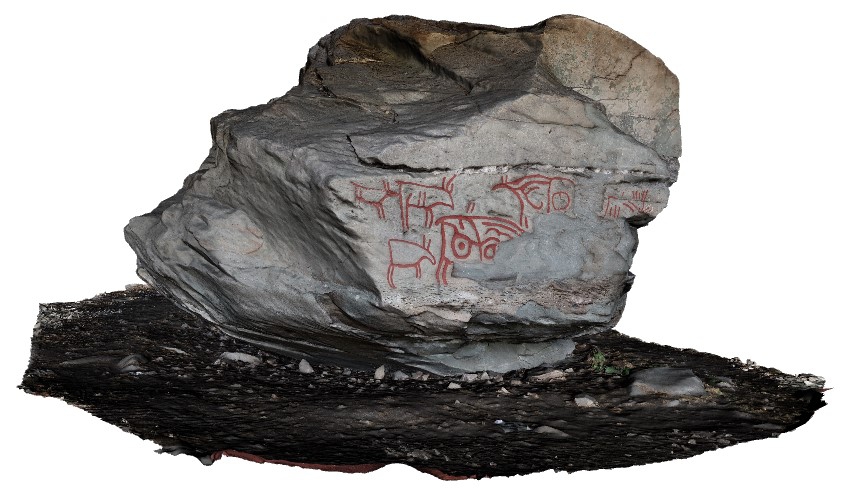
The aim of this research initiative is to increase the knowledge-potential of rock art, by facilitating innovative research and creative dissemination. The initiative includes rock carvings from the Stone Age, Bronze Age, and Iron Age, as well as rock paintings. Rock art was created in the varied landscapes of southern Norway through more than 8000 years, by groups with different adaptations, and through shifting cultural circumstances.
ARTSCAPE will build on and contribute to existing rock art archives and develop new perspectives in dialogue with ongoing research. A main aim is to contextualize rock art, through qualitative as well as quantitative approaches to motives and sites.
The digital revolution has been a game changer for rock art studies. Digital documentation techniques have increased our ability to interpret the imagery and to explore aspects such as the temporality of rock art panels and their landscape setting. Theoretical discussions have contributed to a stronger integration between rock art studies and prehistoric archaeology in a wider sense.
Research Areas
Through several sub projects, ARTSCAPE explores rock art as a temporal and historical phenomenon, as artistic expressions, and as cultural heritage:
- Rock art formats in the landscape in a diachronic perspective
- Temporality and space/topography (micro and macro level)
- Variety of motives and iconographic analysis
- Cross-cultural comparison and narratology
- The significance of rock art in burial contexts
- Documentation protocols aimed at preservation and outreach
In 2024–2025, the group will conduct pilot studies with regional or thematic focus, with the potential to be developed further into research projects. Workshops and visits to rock art sites will be organized, as well as invited seminars and open lectures. Results will be disseminated at conferences and in popular science fora.
Developing Digital Documentation Techniques
Together with the Directorate for Cultural Heritage and altogether eight county councils in Norway, the Museum of Cultural History is responsible for the management and documentation of rock art in southeastern Norway. This amounts to 60 percent of the known rock art sites in Norway. New sites are discovered every year by private persons who collaborate with heritage authorities.
The Museum of Cultural History contributes to the development of digital documentation techniques, among these 3D, and is part of an ongoing initiative hosted by The University Museum of Bergen to develop a national, digital infrastructure for rock art documentation.
- View digital models of rock carvings, maps and excavations
- When Darkness Falls, Three Friends Find Ancient Art, an article in The New York Times about rock art hunters in Norway (04.01.2023)
Collaboration
- Aarhus University
- University of Gothenburg
- The Tanum Rock Carving Museum
- Swedish Rock art Research Archives
- University museums in Norway
- County councils of Agder, Telemark, Vestfold, Østfold, Buskerud, Innlandet, Akershus and Oslo